Preschool Music Lessons: What to Expect and How to Get Started in Newfoundland
Discover what preschool music lessons teach, which instruments suit young learners, and how to find a qualified early childhood music program in Newfoundland.
Preschool music lessons introduce children ages 3 to 5 to rhythm, pitch, and musical play during the brain's most receptive developmental window. A well-designed class builds language readiness, motor coordination, and social confidence, all through songs, movement, and guided instrument exploration that feel like pure fun to young learners.
Why the Preschool Years Are the Ideal Window for Music Learning
Research suggests that by age 5, roughly 90% of core brain architecture is already formed. That striking figure explains why music teachers consistently point to the preschool years, ages 3 to 5, as one of the richest, most neurologically receptive windows for introducing rhythm, pitch, and musical play to young children. The goal is not a pressure-filled head start but a scientifically supported opportunity to let curious, developing minds absorb musical ideas in the most natural way possible.
How does early music exposure shape cognitive and language development?
When children learn songs, they practise sequencing, memory, and vocabulary all at once. Rhythmic training is particularly connected to phonological awareness, the ability to hear and manipulate sound units in spoken language, which is a core foundation for reading readiness. Songs reinforce new words through repetition, and the act of memorising a melody is itself a layered cognitive task. Children exposed to music lessons before age 5 show measurable gains in early literacy readiness, which makes musical engagement a genuine complement to language learning. For more on how this progression unfolds, see our guide to music lessons for kindergarteners.
The link between music and fine and gross motor skill development in young children
Gross and fine motor pathways mature together during ages 3 to 5, and music activities map perfectly onto that development. Gross motor skills, the large-body movements like clapping, stomping, and dancing to a beat, are accessible even to toddlers. Fine motor skills, the precise finger movements needed to pluck a string or press a piano key, emerge gradually as hand muscles strengthen. Drum and body-percussion activities build bilateral coordination by asking both sides of the body to work together. Activities like tap-and-clap patterns, finger-play songs, and shaker work give children a physical vocabulary for rhythm long before they can read a note.
Emotional and social growth through shared music-making
Group singing and call-and-response games teach emotional development alongside musicianship. When one child sings back an echo phrase, they are practising turn-taking, listening, and self-regulation simultaneously. Shared rhythm activities build group cohesion in a way that feels entirely natural to kids, because it is fundamentally rooted in fun and play. A skilled music teacher creates a class environment where children feel safe to try, stumble, and try again, which is exactly the kind of low-stakes emotional expression that preschoolers need.
What brain development research tells music educators about the ages 3 to 5
Neuroplasticity peaks in early childhood, and the auditory cortex is particularly responsive during this window. The brain is wired to detect patterns, and music is essentially organised sound patterns, which is why preschoolers absorb melodies and rhythms with striking ease. Teaching music at this stage works best when lessons are structured yet playful, because young brains consolidate new learning through a combination of repetition and novelty. An age-specific preschool music curriculum, such as the Kindermusik Level 3 programme designed for ages 3.5 to 6, demonstrates how research-informed sequencing can be woven into joyful, developmentally appropriate experiences for young learners. For more on this, see related industry context.
What Actually Happens in a Preschool Music Lesson
Picture a group of four-year-olds sitting in a circle, shaking egg shakers while their teacher sings a simple hello song. Within two minutes, every child is clapping on the beat, grinning, and waiting for their name to be called. That ordinary moment is packed with musical learning, and it represents what a well-designed preschool music class looks like from the inside. Understanding the format helps parents know exactly what to expect before their child walks through the door.
A typical 20-minute preschool music class from warm-up to cool-down
A well-paced lesson moves through five phases, keeping children engaged while honouring their short attention spans. Each segment lasts only a few minutes, which matches the roughly 2 to 3 minutes per activity that three- and four-year-olds can sustain comfortably. Predictable structure lowers anxiety for sensitive learners because they always know what comes next.
- Greeting or hello song (2 to 3 minutes): Establishes routine, signals that class time has begun, and helps children feel seen individually.
- Movement or action song (5 minutes): Burns energy productively and anchors musical concepts in the body.
- Instrument exploration (5 to 7 minutes): Introduces timbre, dynamics, and cause-and-effect through hands-on play.
- Guided listening activity (3 to 5 minutes): Builds focused attention and auditory discrimination.
- Cool-down or goodbye song (2 to 3 minutes): Signals closure and sends children out calm and satisfied.
Action songs, body percussion, and movement activities that hold little ones' attention
Music activities like stomp-and-clap patterns, echo songs, and freeze-dance games hold preschoolers' attention because they involve the whole body. Movement anchors musical concepts in memory at this age far more effectively than sitting still and listening. Each activity segment is kept to roughly 3 minutes to match realistic attention spans, and transitions between segments are themselves musical, a sung cue or a steady drum beat, so the rhythm never fully stops. Fun is not incidental here; it is the mechanism by which learning sticks.
Guided listening and sound exploration as a foundation for musical understanding
There is a meaningful difference between passive listening and guided listening. In a guided exploration listening activity, the teacher asks questions like "Is that sound high or low?" or "Did the music get faster or slower?" These prompts turn a passive experience into an active, analytical one. Sound scarves, listening walks around the room, and homemade shakers made from sealed containers all serve as tactile aids that give children a physical connection to the sounds they are hearing. Distinguishing timbre and pitch at this stage is a genuine precursor skill for later instrument lessons. For structured approaches to this kind of guided activity design, educator strategies for structuring preschool music activities offer a wealth of teacher-tested ideas.
How a structured yet playful music curriculum keeps preschoolers engaged week to week
A strong music curriculum uses progressive repetition: the same song returns each week, but with a new layer added, perhaps a harmony, a new instrument, or a movement challenge. This approach honours how preschool-age brains consolidate skill through familiarity while staying curious because of novelty. The Musicplay PreK curriculum model is one example of standards-aligned sequencing that balances both needs effectively; you can read more about that approach at West Music's overview of the Musicplay PreK programme. A good teacher revisits familiar material while weaving in small surprises that keep each lesson feeling fresh.
Which Instruments Belong in Early Childhood Music Programs?
Should a three-year-old be sitting at a full-size piano from day one? Or does musical development naturally begin somewhere simpler, somewhere closer to the body itself? Choosing the right instrument for a preschooler is less about prestige and more about matching the tool to what small hands, short attention spans, and developing ears can genuinely do well right now. The good news is that the earliest instrumental music experiences do not require anything expensive or complicated.
Why percussion instruments are the natural starting point for preschoolers
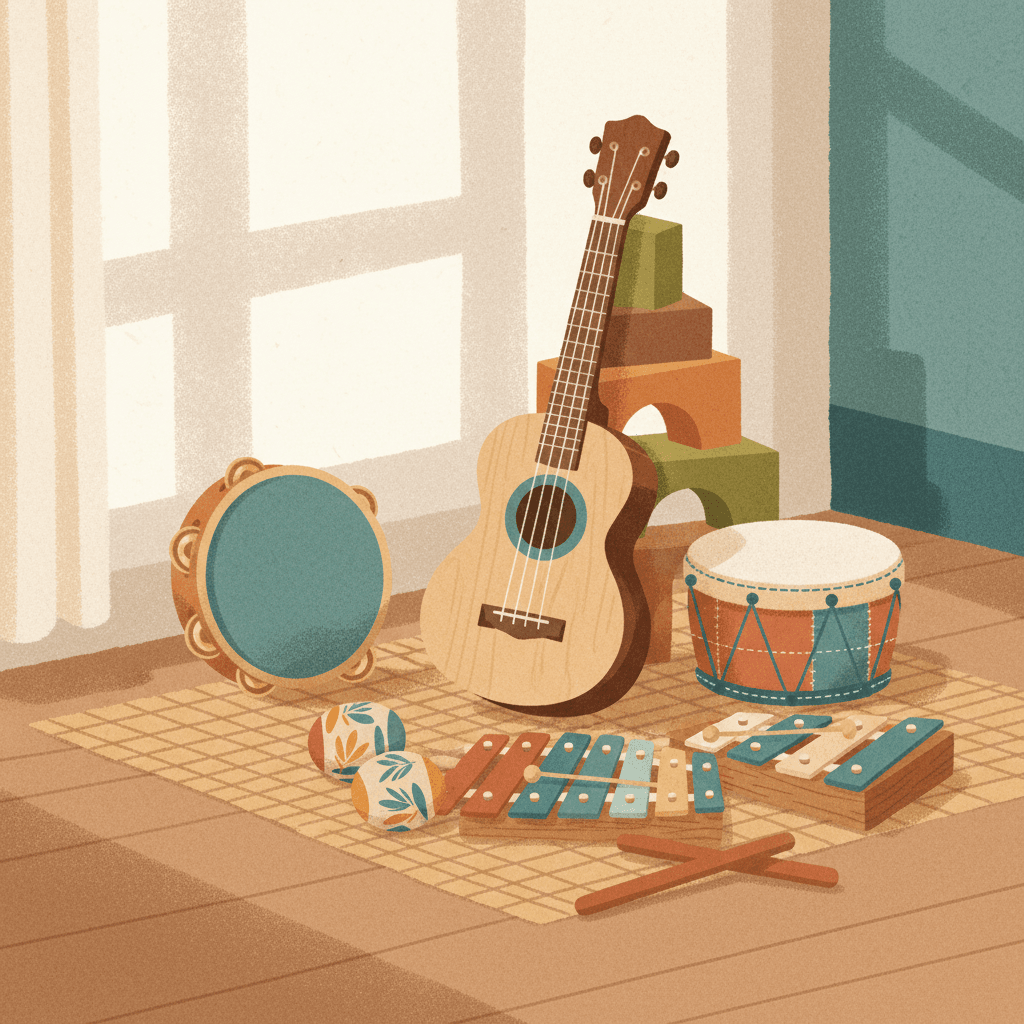
Gross motor coordination comes before fine motor, which is exactly why drum and percussion instruments are the most developmentally appropriate starting point for young children. Egg shakers, hand drums, tone blocks, and tambourines all respond immediately to a child's touch, which gives instant feedback and sustains motivation. Exploratory percussion play at ages 2 to 3 is pedagogically sound even before any formal technique is introduced, because the child is building an intuitive relationship with rhythm and sound that will underpin everything they learn later.
When is a child ready to begin piano or ukulele lessons?
Fine motor skills needed for piano keys typically emerge around ages 4 to 5, making that the general readiness benchmark. Ukulele is slightly more forgiving on hand size because its 4 strings and smaller neck create less distance for small fingers to stretch. Readiness is not determined by age alone; it also depends on attention span and the ability to follow a two-step instruction. Our detailed guide on piano lessons for 3-year-olds explores early readiness markers in practical depth.
| Instrument | Typical Readiness Age | Key Developmental Requirement | Notes |
|---|---|---|---|
| Percussion (shakers, drums) | 2 to 3 years | Gross motor coordination | No technique needed; pure exploration |
| Voice (singing) | Birth onward | None; innate | Matching pitch develops with practice |
| Piano | 4 to 5 years | Fine motor control, sustained attention | Short keys; finger independence needed |
| Ukulele | 4.5 to 5 years | Basic hand strength, 2-step instruction following | Smaller neck than guitar; manageable |
| Guitar | 6 years and up | Stronger finger pressure, longer attention span | See guitar lessons section for details |
Voice as the first instrument: singing in early childhood music education
The voice requires no purchase, no particular hand size, and no prior skill. Singing simple songs is accessible to every child from the very first lesson. Matching pitch is a learned ability that improves with guided practice, not a talent that children either have or lack. Group singing in a class setting builds confidence before any instrument is introduced, because children hear each other and feel supported by the collective sound. For more on the holistic value of early voice work, holistic early childhood music development is explored in depth at Edquisitive Montessori. Kids who begin with singing often approach their first instrument with noticeably more musical intuition.
How to Choose the Right Preschool Music Program or Teacher
Not every music class that calls itself "preschool-friendly" actually is. A programme designed for school-age children scaled down to shorter sessions is not the same as one built from the ground up around how three- and four-year-olds learn, and the difference shows quickly in whether a child thrives or loses interest after the first few weeks. Parents who know what to look for can find a genuinely appropriate programme much faster.
What should parents look for in a qualified early childhood music educator?
Specific markers of genuine early childhood expertise include training in early childhood music pedagogy, regular use of movement-based music activities, and the ability to explain the developmental rationale behind each lesson element. A qualified music teacher welcomes parent observation rather than discouraging it, and can clearly articulate why the hello song comes before the instrument exploration, not just that it does. Children thrive when their teacher understands developmental stages, not just musical technique. Madison Curtis's approach offers a locally grounded example of transparent, qualified early childhood music education in Newfoundland.
Private lessons vs. small-group preschool music classes: which fits your child better?
Private lessons offer individualised pacing and direct attention from the teacher, which suits children who need more one-on-one support or who are ready to move quickly. Small-group classes of 4 to 8 students offer something equally valuable: social modelling, peer energy, and the experience of making music together. Many children thrive in a group setting first and transition to private lessons around age 5 or 6, once they have built basic confidence and a willingness to take instruction. Both formats have genuine merit, and the right choice depends on your child's temperament. Parents exploring private options can also browse kids' piano lessons near me for a broader sense of what individual instruction looks like.
Questions to ask before enrolling in a local music program
Before committing to any program, ask these questions directly:
- What is the curriculum structure, and how does it sequence musical concepts over the term?
- What early childhood music teacher training or credentials does the instructor hold?
- How long is each lesson or class session, and how many children are in each group?
- What is the school's privacy policy for online enrolment forms and student records?
- Is a trial class available before full enrolment?
- How is the policy on parent observation handled?
Transparent answers to all of these signal a professionally run, child-centred program.
Supporting Your Young Learner at Home Between Lessons
Think of a preschool music lesson as planting a seed. The teacher creates the conditions, but the real growth happens in the days between classes, in the kitchen, the car, and the living room, where familiar songs get hummed and rhythms get tapped on the dinner table without anyone calling it practice. Home musical support is simple, low-pressure, and woven naturally into daily life rather than requiring a separate structured session.
Simple daily music activities that reinforce what children learn in class
Small moments of musical engagement throughout the day add up quickly. Try any of these:
- Hum or sing the week's song during car rides to help your child learn it through relaxed repetition.
- Clap a simple rhythm at the dinner table and invite your child to clap it back.
- Dance together to a favourite track for 5 minutes after school, pure movement and play.
- Try echo-clapping games before bed: you clap a pattern, they copy it.
- Make a simple shaker from a sealed container filled with rice for fun, low-cost instrument exploration.
How much practice is realistic for a preschool-aged child?
Reframe "practice" as "musical play," because that is genuinely what it is at this age. Five to 10 minutes of informal musical engagement daily is far more beneficial than a single long session once a week. Attention spans at ages 3 to 4 are roughly 6 to 8 minutes for a self-chosen activity, so there is no need to push beyond that. Repeating the same 3 to 4 songs across a full week deepens retention in ways that variety alone cannot. Skipped days are not failures; a relaxed, positive attitude toward musical time is the skill that matters most right now. Avoid formal drill entirely: kids at this stage consolidate learning through joy and repetition, not correction.
How parents and caregivers can participate without taking over
Model enthusiasm rather than correction. Sing alongside your child rather than critiquing whether their pitch is accurate, because parental singing engagement at home is one of the strongest predictors of early musical confidence in children. Follow your child's lead: if they want to bang a drum for 7 minutes, that is valid and valuable musical exploration. Your engaged presence matters far more than your musical ability. Madison Curtis warmly welcomes parent participation in group class settings, because a supportive adult in the room amplifies everything the lesson accomplishes. For a related perspective on teacher-family collaboration across the lesson journey, see how a music teacher prepares students for a recital.
Preschool Music Lessons in Newfoundland's Avalon Region
Music has long been woven into the fabric of Newfoundland community life, through kitchen parties, school concerts, and the centuries-old tradition of passing songs from one generation to the next. That cultural richness gives preschool music education in the Avalon region a distinctive warmth and rootedness that formal curriculum alone cannot replicate. Families here are not starting from a blank slate; they are building on a living musical tradition.
What makes community-rooted music education in Newfoundland distinctive
A music teacher embedded in the Avalon community can draw on local songs, folk melodies, and seasonal traditions as natural lesson material for children. This cultural grounding supports identity and belonging alongside music skill, which matters in early childhood when sense of place is actively forming. Rather than importing a generic programme, locally rooted lessons reflect the sounds a child already hears at home. For families interested in musical learning beyond the preschool years, adult music lessons in Newfoundland offer a picture of how this community-centred approach continues to serve learners at every age.
Group workshop formats available for young learners across Avalon communities
Workshop formats offer a low-commitment entry point into preschool music before families enrol in weekly classes. A single-session or short-series workshop might focus on seasonal songs, rhythm exploration, or an introduction to a specific instrument. Kids from across Avalon programme areas including St. John's, CBS, Placentia, and surrounding communities can participate, and groups are kept small, typically 4 to 8 young learners, to ensure meaningful participation. Workshop classes are also a gentle way to see whether your child is ready for kindergarten-level group instruction. Parents interested in exploring the next step can browse finding a qualified local teacher for kids' piano lessons or reach out to Madison Curtis directly to ask about current availability and upcoming workshop dates.
Key Takeaways
- Ages 3 to 5 are a prime window for music learning: the brain is highly receptive to rhythm, pitch, and pattern during this period, making early exposure genuinely valuable rather than just enriching.
- A well-structured 20-minute lesson moves through greeting, movement, instrument exploration, guided listening, and cool-down, each phase serving a specific developmental purpose.
- Percussion first, then pitched instruments: children are typically ready for piano or ukulele around ages 4 to 5, while shakers and drums are accessible from age 2 to 3.
- Home support means 5 to 10 minutes of musical play daily, not structured practice; humming songs in the car and clapping rhythms at the table are genuinely effective.
- Ask about curriculum, group size, teacher qualifications, and privacy policy before enrolling; a strong programme can clearly explain the developmental rationale behind every activity.
FAQ
What age can a child start preschool music lessons?
Most children are ready for structured preschool music classes between ages 3 and 4, though informal musical engagement through singing and percussion can begin from infancy. At age 3, children can typically follow simple instructions, take turns, and sustain attention for 2 to 3 minutes per activity, which is all a well-designed class requires to get started.
Are preschool music lessons different from regular music lessons?
Yes, significantly. Preschool music lessons are built around movement, singing, and exploration rather than technique or notation. Activities are kept to 2 to 5 minutes each, the lesson arc is predictable to lower anxiety, and the emphasis is on developing rhythm, language, and social confidence rather than mastering an instrument. School-age lesson formats are not simply scaled down; they are structured differently from the ground up.
How long should a preschool music lesson be?
A typical preschool music lesson runs 20 to 30 minutes. That duration matches the realistic attention span of a 3 to 5-year-old and allows enough time to move through a greeting song, a movement activity, instrument exploration, a listening component, and a calm goodbye song without any segment feeling rushed or overlong.
Do preschool children need to practise at home?
Not in the formal sense. Five to 10 minutes of informal musical play daily, such as singing the week's song, clapping rhythms, or dancing to music, is far more appropriate and effective than structured practice sessions. Repetition of 3 to 4 familiar songs across the week deepens retention. Skipped days are a normal part of early childhood learning and do not set a child back.
What is the best first instrument for a preschooler?
The voice is the most developmentally natural starting point, requiring no purchase and no physical prerequisite. After voice, percussion instruments like egg shakers, hand drums, and tone blocks are ideal because they respond to gross motor movement, which preschoolers have already developed. Piano and ukulele become appropriate around ages 4 to 5, once fine motor coordination and the ability to follow multi-step instructions are in place.
How do I find a qualified preschool music teacher in Newfoundland?
Look for a teacher with specific early childhood music pedagogy training, not just general music teaching credentials. Ask whether they use movement-based activities, can explain the developmental rationale for their lesson structure, and whether they welcome parent observation. A transparent privacy policy for enrolment forms and student records is also a sign of a professionally run programme. Madison Curtis offers locally rooted preschool and early childhood music instruction across the Avalon Peninsula.