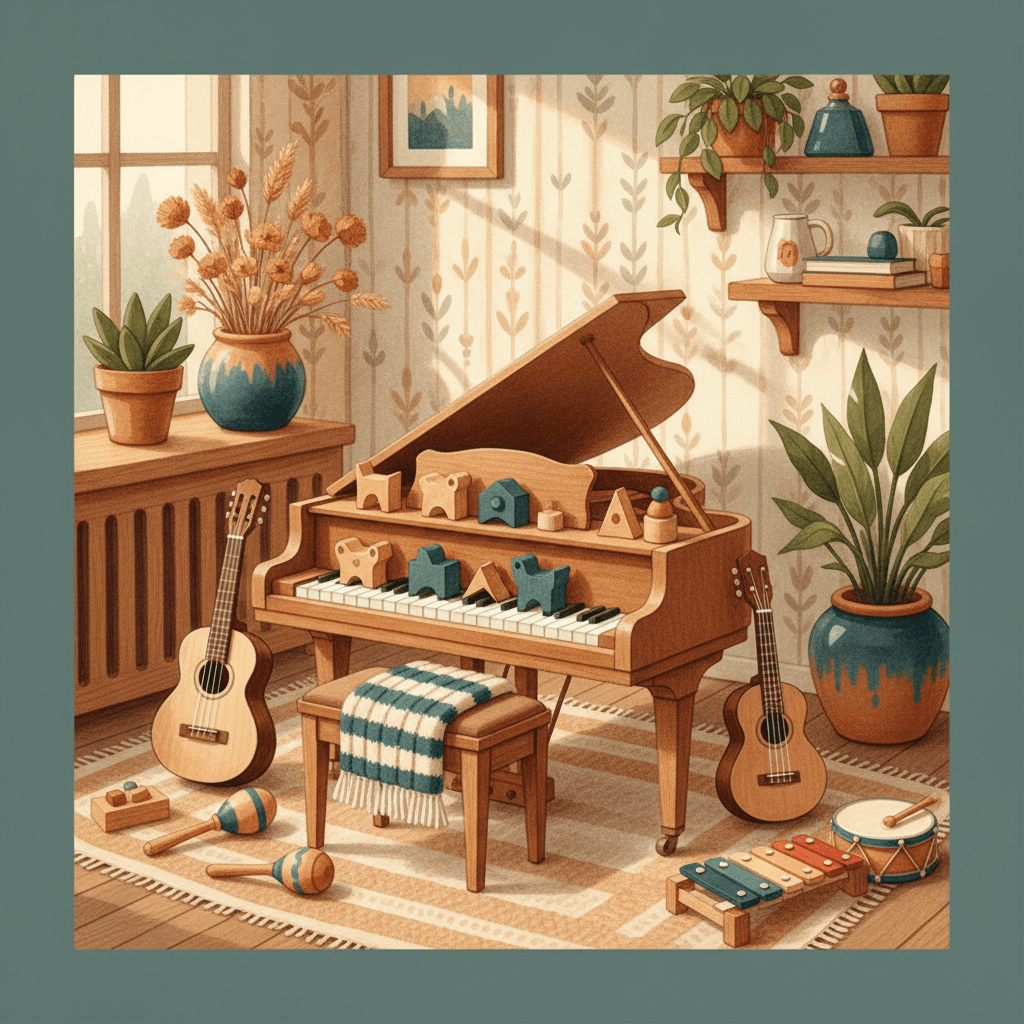
Piano Lessons for 3-Year-Olds: A Practical Guide for Parents
Discover how piano lessons benefit 3-year-olds, what real lessons look like, and how to support your child at home with expert, play-based guidance.
Piano lessons can genuinely work for 3-year-olds when they are designed around how toddlers actually learn: through play, imitation, and short bursts of joyful exploration. At this age, readiness means musical curiosity, not sitting still. The right teacher and approach can build real skills while keeping every minute fun.
Is Your 3-Year-Old Ready for Piano Lessons?
What does readiness actually mean for a toddler sitting down at a piano keyboard for the very first time? Many Newfoundland parents assume readiness looks like sitting still and following instructions, but at age 3, readiness is something far more playful, instinctive, and wonderfully messy than that.
What developmental readiness actually looks like at this age
Readiness for a 3-year-old child does not mean perfect obedience or the ability to read a page of music. It means showing curiosity when a sound catches their attention, and being willing to imitate a simple gesture or repeat a short musical phrase. At this age, learning happens through exploration rather than instruction, and a good teacher leans into that fully.
Can a toddler really learn piano, or is it too early?
The honest answer is yes, with realistic expectations in place. Formal technique such as precise fingering and posture is secondary at this stage. What a 3-year-old can genuinely absorb is a love of music, basic awareness of high and low sounds, and the simple pleasure of making something happen on the keys. Many professional pianists began playing around ages 3 to 4, which reflects how naturally young children take to the instrument when the approach suits their developmental stage.
Signs your child is showing musical curiosity worth nurturing
Some observable signs that your child may be ready to explore piano include:
- Spontaneously singing, humming, or making up little melodies throughout the day
- Tapping rhythms on tables, floors, or their own knees while listening to music
- Wanting to touch a piano, keyboard, or any instrument they encounter
- Responding physically to music by dancing, swaying, or bouncing
- Requesting the same songs repeatedly and visibly delighting in them
- Imitating musical sounds they hear from recordings, other children, or adults
These behaviours are fun to observe and genuinely meaningful. None of them guarantee a smooth path into lessons, but together they signal the kind of musical curiosity that a skilled teacher can nurture beautifully.
How a 3-year-old's fine motor and cognitive stage shapes lesson design
At age 3, finger isolation, pressing one key cleanly without dragging adjacent fingers along, is still maturing and typically consolidates between ages 3.5 and 4. Bilateral coordination, using both hands independently, is even further down the developmental road. A child's working memory at this age is also brief, which means cognitive load must be kept low by embedding learning inside play rather than explanation. Teaching that accounts for these realities looks like songs, games, and imitation rather than exercises. It is also why how lessons evolve as children approach kindergarten age is such a useful thing for parents to understand early on, so expectations can grow alongside the child's capacity.
NAfME recognizes early childhood music learning as developmentally valuable from birth onward, reinforcing that age 3 marks a natural and meaningful entry point into structured musical exploration within the preschool developmental stage spanning ages 3 to 5.
Real Benefits of Starting Piano Early (Backed by Child Development Research)
Children who receive structured music education before age 5 show measurable advantages in phonological awareness, the same skill that underpins reading. That single finding, supported by multiple peer-reviewed studies, gives parents a compelling reason to consider private piano lessons long before the first day of school.
How childhood music learning supports language and literacy growth
Rhythm and language share deep neural roots. When a child claps a beat, they are practising syllable segmentation, the same cognitive action involved in sounding out words. Research consistently links early music education to stronger phonological awareness, which is associated with more confident early reading. Music does not guarantee literacy gains, but it supports the same foundational skills in a way that feels completely natural to a young learner.
What does learning piano do for a toddler's brain?
Learning piano at this age involves both hands working in coordination, which activates both brain hemispheres simultaneously. Neuroscientists have noted this bilateral activation as one of the distinctive features of musical training. Even at a beginner level, a child is engaging fine motor neural pathways, building working memory through short melodic patterns, and processing time and rhythm as organized structures. These are not abstract benefits; they show up as improved coordination, concentration, and musical confidence over time.
Social and emotional gains from music education in the preschool years
For young children, music education is also an emotional and social experience. In small-group settings, kids practise turn-taking and attentive listening, skills that transfer directly to classroom life. In individual lessons, a child builds a trusting one-on-one relationship with a teacher, which supports emotional security and communication. Musical expression also gives children a non-verbal outlet for feelings they may not yet have words for. Research underpinning musical readiness and parent-child music education shows that children in music-rich environments develop stronger pitch discrimination by around age 4.
Why consistent early music exposure builds long-term musical confidence
There is an important distinction between passive exposure, hearing music in the background, and active structured learning piano at the piano. Consistent weekly contact with music builds what educators call auditory schema: internalized patterns of pitch, rhythm, and melody that make later skills feel familiar rather than foreign. A child who has spent two years exploring music before entering Grade 1 typically finds note-reading and basic music theory far less intimidating than peers encountering these concepts for the first time. That early scaffolding quietly shapes confidence for years. Parents interested in finding ongoing piano lessons for kids in your area will find that consistency of teacher and format makes a meaningful difference at this age.
What Piano Lessons for 3-Year-Olds Actually Look Like
Picture a 3-year-old arriving at their very first piano lesson. Before the teacher has finished saying hello, small hands are already pressing every key within reach, and the child dissolves into giggles at the low rumble of the bass notes. A skilled teacher lets that curiosity run for a full 2 minutes before gently guiding things toward something a little more structured.
Typical lesson length and attention-span realities for preschoolers
For a child of this age, a lesson should run no longer than 20 to 30 minutes. The average attention span for a 3-year-old on a single structured task is roughly 6 to 8 minutes, so the lesson needs to shift gears frequently, incorporating movement breaks and varied activities throughout. Teaching in short bursts rather than long explanations keeps the child present and willing. Reading about what parents should know before starting piano at age 3 can help set realistic expectations before the first lesson begins.
How play-based teaching replaces traditional piano technique drills
At age 3, formal technique drills are simply not yet appropriate. Instead, a good teacher uses games to introduce foundational concepts: playing high keys for bird sounds and low keys for elephants, clapping a rhythm before attempting to play it, or naming keys after characters in a simple story. These activities teach pitch, dynamics, and pulse in a way that feels like pure fun to the child. The method behind the play is intentional; it builds musical instincts that formal technique can be layered onto later, when the child is developmentally ready.
What a sample first piano lesson with a 3-year-old might include
A well-designed first lesson might flow through steps like these:
- Welcome and free keyboard exploration (approximately 2 minutes): let the child press keys freely, making sounds and discovering the instrument at their own pace.
- Clapping or tapping a simple rhythm together: teacher claps a short pattern, child echoes it back.
- Learning the names of 2 to 3 keys using a song or story: a musical narrative gives each note a character or colour that a preschooler can remember.
- Playing a 2-note or 3-note simple melody by ear: no reading required; the child follows the teacher's demonstration and plays by imitation.
- A movement activity: marching to a steady beat around the room, reinforcing pulse with the whole body.
- Goodbye song or ritual: a consistent closing routine signals the end of the lesson and builds a comforting structure.
Private lessons vs. small-group music classes, which suits toddlers better?
Both private piano lessons and small-group formats have genuine merit for piano students at this age. Private lessons allow fully individualized pacing, meaning the teacher can follow the child's energy and curiosity without needing to manage the group. Small-group classes of 3 to 5 students add social modelling, where a child watches peers attempt something and gains confidence to try it themselves. Neither format is universally superior; the best choice depends on the individual child's temperament and the teacher's approach.
| Feature | Private Lessons | Small-Group Classes |
|---|---|---|
| Best for | Children who need individualized pacing | Children who thrive with peer modelling |
| Typical group size | 1 student | 3 to 5 students |
| Lesson pacing | Fully tailored to one child | Shared pace across the group |
| Social element | One-on-one teacher relationship | Peer interaction and turn-taking |
| Cost consideration | Varies by teacher and format | Varies by teacher and format |
How Madison Curtis structures early childhood piano lessons across the Avalon
Madison Curtis's approach to music education in Newfoundland centres on play-based, developmentally informed teaching that meets each child where they are. Across the Avalon Peninsula, lessons are shaped around curiosity rather than compliance, with a curriculum that uses movement, story, and song to build genuine musical understanding at each child's own pace. The teaching philosophy respects what a 3-year-old's brain and body are actually ready for, making lessons feel like the best part of the week rather than a structured obligation.
Choosing the Right Piano Method for Preschool Students
Piano pedagogy for very young children has shifted considerably over the past 40 years, moving away from adult-scaled notation books toward approaches that honour how preschoolers actually learn. Movement, imitation, storytelling, and repetition now anchor the best early-childhood curricula, rather than notation-first instruction that simply overwhelms a 3-year-old.
What makes a preschool piano curriculum different from beginner method books for older kids?
Traditional method books such as those from Faber or Alfred typically target children aged 5 and up, often requiring a Grade 1 reading level to navigate the text and follow instructions. A preschool-specific piano method like Music for Little Mozarts or Wunderkeys works very differently: it introduces musical concepts through characters, stories, and illustrations rather than standard notation. The curriculum scaffolds learning through a child's imagination rather than their literacy, which is precisely the right approach at this developmental stage.
Key features of an effective early-childhood piano method
Quality early-childhood piano methods tend to share several recognizable features:
- Uses characters or stories to give musical concepts a memorable, concrete identity
- Introduces rhythm and beat through movement and clapping before any notation appears
- Incorporates physical activity as part of the learning sequence, not as a break from it
- Builds listening skills progressively, training the ear before training the eye
- Uses large-print visuals and colour-coded keys to reduce cognitive load
- Keeps pieces short, typically 4 to 8 bars, so a child can experience success quickly
Music teachers working with children under age 5 are encouraged by MTNA to pursue specific early childhood pedagogy training, reflecting how distinct this work is from teaching older beginners.
How music theory is introduced gently at this developmental stage
Rushing a 3-year-old into reading music from a traditional staff is one of the most common missteps in early piano teaching. A developmentally sound approach begins with concepts the child can feel and hear: high sounds versus low sounds, loud versus soft, fast versus slow. Beat and rhythm are introduced through body movement long before a child marks a note on paper. Solfège syllables or colour-coded keys can serve as helpful bridges between aural understanding and eventual notation. This gradual sequence protects the child's confidence and ensures that learning piano feels manageable rather than overwhelming at every stage of early development.
How to Keep 3-Year-Olds Engaged and Having Fun at the Piano
A bored 3-year-old at a piano bench is not a motivation problem. It is a lesson design problem. Engagement at this age is the shared responsibility of the teacher and the parent, and a child who seems disinterested is usually sending a clear signal that the activity needs to change, not that the child lacks aptitude.
Why short, interactive activities outperform structured drills every time
A 3-year-old's brain is wired for novelty. When an activity stays the same for too long, attention naturally drifts, which is a neurological reality rather than a character flaw. Switching activities every 5 to 7 minutes tends to maintain engagement for most preschoolers, keeping the brain stimulated without tipping into overwhelm. Short, interactive tasks consistently outperform longer drills for this age group because they match the child's natural learning rhythm, making the whole experience feel like play rather than work.
Songs, games, and movement ideas that hold a toddler's attention
These practical ideas work well during lessons and are equally useful for parents at home:
- Call-and-response singing games where the child echoes a short musical phrase back to the teacher
- Clapping a rhythmic pattern together before attempting to play it on the keys
- Using a stuffed animal as a pretend student that the child "teaches," reinforcing concepts through role play
- Marching around the room to a steady beat, connecting bodily movement to musical pulse
- Tapping high keys for birds and low keys for elephants while the teacher narrates a simple story
- Echo-playing short 2-note patterns by ear, building listening skills alongside keyboard familiarity
How do you teach piano to a child with a very short attention span?
Short attention span at age 3 is entirely normal and should never be framed as a problem. A skilled teacher designs the lesson around it rather than against it. Rotating activities every few minutes, embedding genuine choice (do you want to play the elephant keys or the bird keys first?), and responding to the child's energy rather than the clock are all practical ways to keep a toddler engaged throughout a lesson. The goal is a child who leaves feeling successful and happy, not a child who has endured a full 30 minutes of sitting still.
Adjusting pace and energy when a preschooler loses focus mid-lesson
Every teacher who works with young children knows the moment: a student's eyes drift, the body starts to wiggle, and the music stops making sense to them. The right response is a quick pivot, not a push to continue. A movement break, a whisper game where both teacher and student play as softly as possible, or an invitation to choose the next song can all reset the child's attention within moments. Distinguishing between genuine fatigue, which calls for winding down, and simple boredom, which calls for a new activity, is a core teaching skill. Reading about how a teacher reads a student's energy to shape the lesson offers useful perspective on this responsive approach to music education.
How Parents Can Support Learning Between Lessons
Think of a weekly lesson as planting a seed. A lesson once a week puts something in the soil, but what happens between lessons is the daily light and water that helps it grow. Parental support at home does not mean becoming a substitute teacher; it means creating an environment where musical growth can continue naturally and joyfully.
What does a realistic home practice routine look like for a 3-year-old?
For a child this age, home practice should run 5 to 10 minutes per session, on 3 to 4 days per week. Consistency matters far more than duration at this stage; even 5 minutes of playful piano exploration on a weekday afternoon keeps the learning alive between lessons. Frame it as piano play time rather than practice, and follow the child's lead on what they want to revisit. There is no need to replicate the lesson at home; simply making time to sit at the keys together is enough.
Setting up a welcoming, distraction-free space for piano exploration at home
A keyboard or piano placed in a high-traffic, visible area of the home is far more likely to attract a 3-year-old's spontaneous attention than one tucked away in a back room. Keep the space tidy and welcoming, with the bench or stool at the right height so the child feels physically comfortable and in control. Removing competing distractions, such as a television in the same room, increases the likelihood that the child will self-initiate a few minutes of exploration between lessons. A wide range of small props, a favourite stuffed animal, a simple rhythm shaker, or even a colourful sticker on a key the child is learning, can make the space feel like an inviting place to explore rather than a place where performance is expected.
Key Takeaways
- Age 3 is a developmentally appropriate time to begin private piano lessons, provided the teacher uses a play-based, child-centred approach suited to the preschool stage.
- Lessons should be 20 to 30 minutes long, with activity switches every 5 to 7 minutes to match a 3-year-old's natural attention window.
- Piano method curricula like Music for Little Mozarts and Wunderkeys demonstrate that storytelling and movement, rather than notation-first teaching, are the most effective entry points for this age group.
- Parents support learning most effectively by creating a welcoming home environment and framing daily keyboard time as play, not structured practice.
- Early music engagement is associated with stronger phonological awareness, bilateral brain activation, and social-emotional skills that benefit children well beyond the piano bench.
FAQ
At what age should a child start piano lessons?
Most qualified music teachers consider age 3 to 4 a reasonable starting point, provided the approach is genuinely play-based and the lessons are short. Some children are ready closer to age 5 or 6, particularly if they show limited interest in sitting at an instrument. The child's curiosity and ability to follow simple, brief instructions are more reliable readiness indicators than age alone.
How long should a piano lesson be for a 3-year-old?
A lesson for a 3-year-old should run between 20 and 30 minutes maximum. Within that time, activities should shift every 5 to 7 minutes to match the child's natural attention span. Longer lessons tend to produce frustration rather than progress at this age. Quality and engagement within a short session are far more valuable than duration.
What should I look for in a piano teacher for a toddler?
Look for a teacher who:
- Has specific experience or training in early childhood music education
- Uses play-based method books and approaches rather than notation-heavy drills
- Communicates warmly and patiently with both the child and the parent
- Keeps lessons short and flexible
- Is recommended by MTNA-affiliated networks or local music education communities
Do I need a full-sized piano at home for a 3-year-old?
A full-sized acoustic piano is not required at the beginning. A quality digital keyboard with weighted or semi-weighted keys and at least 61 keys is a practical starting point. The most important factor is that the instrument is accessible, set up at a comfortable height, and treated as an inviting play space rather than a formal station.
How much home practice is realistic for a 3-year-old?
Five to ten minutes of playful keyboard exploration on 3 to 4 days per week is a realistic and productive target. At this age, consistency across the week matters more than the length of any single session. Parents should frame home time at the piano as play rather than practice, following the child's interest and energy rather than a fixed routine. For more ideas on supporting young learners, visit the Madison Curtis blog.