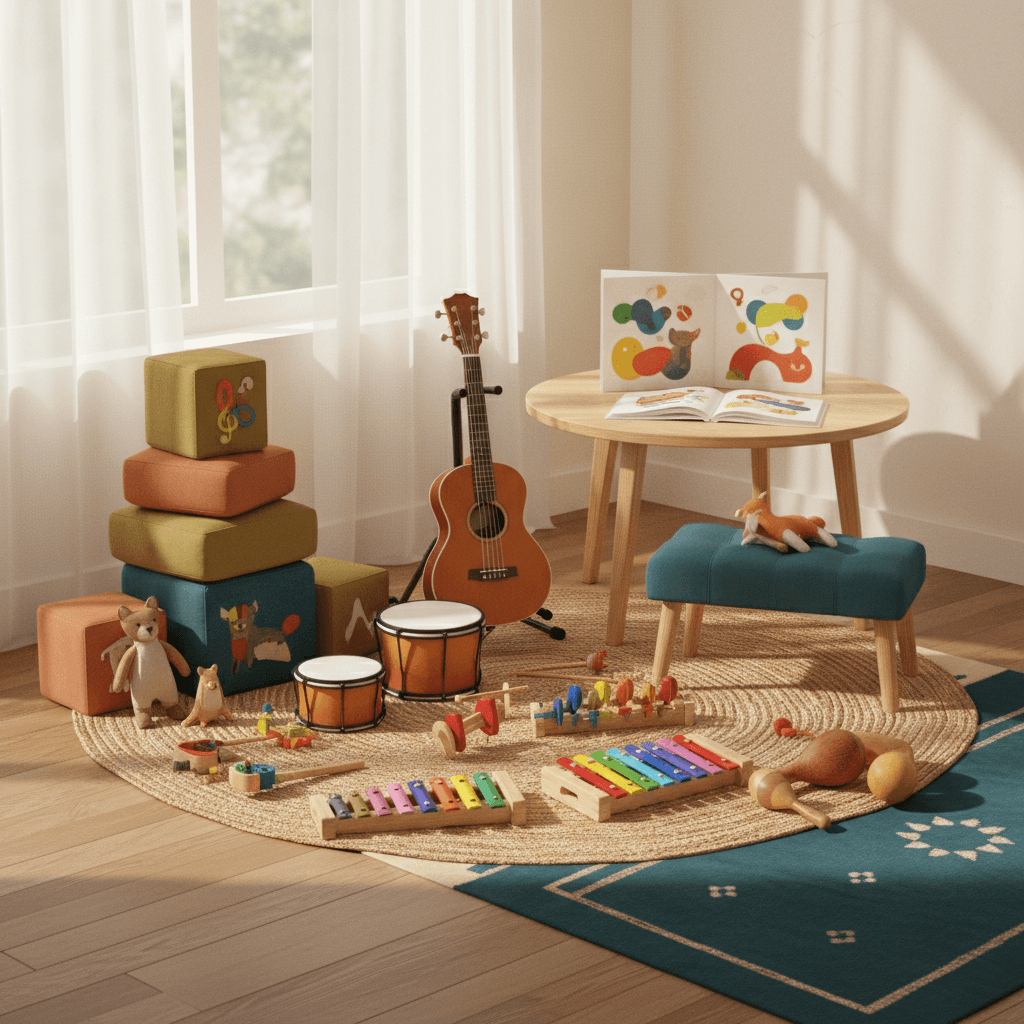
Music Lessons for Kindergarteners: What Parents Need to Know
Discover how kindergarten music lessons build rhythm, pitch, and focus through play. Find age-appropriate formats, practice tips, and local Newfoundland options.
Music lessons for kindergarteners work best when they look less like formal instruction and more like guided play. Five-year-olds learn rhythm, pitch, and listening through movement, song, and short activity blocks, building real musical skills alongside language, memory, and fine motor development in the process.
What Do Music Lessons for Kindergarteners Actually Look Like?
Most parents picture a kindergartener sitting still at a piano bench for 30 minutes. That picture is almost entirely wrong. Real music lessons for kindergarten look more like guided play than formal instruction, and that is exactly what the research on early childhood learning supports. Movement, storytelling, and song come first.
Five-year-olds have an average sustained-attention span of roughly 5 to 10 minutes per task, which means a single long activity simply does not hold. Developmentally, kindergarten age aligns with Piaget's preoperational stage (ages 2 to 7), during which children learn best through concrete, sensory experience rather than abstract symbols. Methods like Orff and Kodály were designed specifically around this reality. Early-childhood music education grounded in these approaches prioritises participation over performance.
How are kindergarten music lessons different from older-student lessons?
In grades 3 and beyond, music instruction can introduce written notation, music theory worksheets, and more sustained practice on a single piece. For kindergarteners, none of that is appropriate yet. A child still building reading skills cannot be expected to decode a staff simultaneously. Instead, lessons centre on music and movement, call-and-response singing, and responding to sound with the whole body. Responding to changes in tempo or dynamics through physical action is how five-year-olds internalise musical concepts before those concepts need names.
Typical lesson length and pacing for five-year-olds
A well-structured lesson runs 20 to 30 minutes, divided into micro-segments of roughly 5 to 7 minutes each. Staying in any single activity longer than that risks losing the child's attention entirely. Every lesson in a well-designed music program for young learners follows this rotating-block structure, so each short segment feels fresh. Smooth transitions between segments, often cued by a signal song, keep the lesson flowing without chaos.
Private lessons vs. small-group music classes for young learners
Both formats work well for kindergarteners, and the right choice depends on the individual child. Private lessons allow a teacher to move at the student's exact pace and give immediate, personalised feedback on pitch matching or finger placement. Small-group music classes, on the other hand, provide something private lessons cannot replicate: peer modelling. Watching another five-year-old clap a rhythm successfully gives a hesitant child both a concrete example and the social courage to try. For families exploring piano specifically, kids' piano lessons near me outlines what to expect in each format. For more on this, see related industry context.
What Kids Learn in Kindergarten Music Education
A 2019 analysis cited by the National Endowment for the Arts found that children with consistent early arts participation show measurable gains in language processing and working memory by age seven. For kindergarteners in a well-designed music program, that learning starts with something as simple as clapping a steady beat.
Ages 5 to 6 represent a critical window for auditory discrimination development. Singing in tune typically solidifies between ages 5 and 8, making this the ideal time to nurture pitch matching through gentle, game-based practice. Fine pincer grip, needed for piano keys and ukulele strings, is still maturing at age 5, which means activities must be adapted to meet children where they are physically.
4 core skills kindergarteners build through music lessons:
- Steady beat and rhythm patterns
- Pitch matching through singing
- Focused listening
- Fine motor coordination
Rhythm, pitch, and early musical concepts introduced at this stage
The concept rhythm arrives not as a written note value but as a felt pulse. Children tap steady beats on their knees, clap patterns they hear, and echo short rhythmic phrases back to their teacher. Call-and-response songs build pitch awareness while keeping participation low-stakes. Body percussion, clapping, stomping, and patting, anchors musical patterns in physical memory long before any notation is introduced. These patterns lay the groundwork for all future music reading.
Fine motor skills and physical coordination through singing and instruments
Play an instrument at age five and you are actually doing physical therapy of the most enjoyable kind. Piano playing develops finger independence one key at a time. Ukulele strumming builds hand-eye coordination and bilateral coordination, a developmental milestone that typically consolidates around age 5. Singing involves breath control, posture awareness, and diaphragm engagement, all of which strengthen core body awareness. Even simple exercises in creating rhythms or melodies reinforce the fine motor pathways that also support handwriting.
Listening skills and music-and-movement activities that build focus
Freeze games, echo songs, and tempo-change activities train children to shift attention quickly and deliberately. This kind of responding through movement directly supports the listening skills that underpin reading acquisition. A child who can hear that a melody slowed down and respond by moving slowly is practising the same sustained-attention muscle they need in a classroom reading circle.
How does early music education support cognitive development?
Music training and phonological awareness share overlapping neural pathways, and research consistently links musical engagement to stronger verbal memory in young students. Musical training at early ages has been associated with meaningful improvements in verbal memory compared with non-trained peers. Working memory gains support everything from following multi-step instructions to learning new vocabulary, making early music study one of the most transferable investments a family can make. For more on this, see related industry context.
How a Kindergarten Music Curriculum Is Structured
Designing a music curriculum for a kindergartener is a lot like planning a good playground: you need clear boundaries, several distinct zones to move between, and enough open space for discovery. Without that structure, a five-year-old's enthusiasm scatters. With it, the same energy becomes genuine musical learning.
A typical well-designed kindergarten lesson rotates through 3 to 4 activity types. Ukulele is playable for children as young as 4 with soprano sizing (21 inches), and piano keyboard exercises are adapted to smaller octave spans for ages 5 to 6.
Sample 25-minute kindergarten lesson block
| Time Block | Activity Type | Musical Focus |
|---|---|---|
| 0 to 5 min | Warm-up song | Voice, breath, pitch |
| 5 to 10 min | Rhythm game | Steady beat, patterns |
| 10 to 18 min | Instrument exploration | Fine motor, listening |
| 18 to 23 min | Listening and movement | Dynamics, tempo response |
| 23 to 25 min | Cool-down | Reflection, transition |
Building a lesson plan around a five-year-old's attention span
Rotating activities every 5 to 7 minutes is not just a convenience; it is a structural necessity. Each transition is cued by a signal song or clap pattern so children know what is coming without needing verbose verbal instructions. Sustained notation work is avoided entirely. This approach aligns with child developmental readiness guidance, which confirms that kindergarteners learn procedural skills through repetition embedded in varied, engaging contexts. Every lesson in a sound music program honours this rhythm.
Musical games and activities that keep young learners engaged
Well-chosen games lower anxiety and increase retention for kindergarteners at this stage. Specific activity types that work well include:
- Call-and-response songs: Teacher sings a phrase, child echoes it back, creating an immediate sense of musical dialogue.
- Body percussion sequences: Clapping, stomping, and patting build rhythm awareness without requiring any equipment.
- Freeze dance: Children move to music and freeze on cue, training listening and self-regulation simultaneously.
- Echo clapping: Short rhythmic patterns are clapped by the teacher and copied by students, reinforcing pattern recognition.
- Simple song books: Picture books with built-in melodies invite exploration moments and link literacy with music naturally.
These activities keep energy high while building genuine musical foundation. Fun is not a distraction from learning at this age; it is the mechanism.
Singing, ukulele, and piano as natural starting points for kindergarteners
The voice is the first instrument every child already owns. Singing requires no equipment and connects directly to language development. The ukulele, with only 4 strings and a compact body, fits small hands naturally and produces a rewarding sound almost immediately. Piano provides a visual map of pitch that helps children understand high versus low in a concrete, spatial way. Each instrument reinforces a different learning pathway.
How do you balance structured teaching with playful exploration?
Vygotsky's zone of proximal development offers a useful lens here: learning happens in the space between what a child can do alone and what they can do with support. In a well-designed lesson, the teacher-led portion gradually gives way to student-led exploration. A child might first echo a rhythm, then creating their own version of it, and finally choose which percussion sound they want to use. That arc from guided to independent is not loosely structured play; it is deliberate pedagogy. Free exploration time at the end of a lesson consolidates what was practised earlier.
Choosing the Right Music Program for Your Kindergartener
How do you know if a music teacher truly understands five-year-olds, or is simply adapting an adult lesson plan downward? The difference shows up fast, in whether your child walks out of the first session excited or overwhelmed. Knowing what to look for makes that evaluation straightforward before you even book a trial lesson.
Look for a teacher with at least 1 to 2 years of early-childhood-specific teaching experience. Trial or introductory lessons are standard practice; expect 1 trial session before committing to a full term. Connecting with qualified music educators who understand developmental stages is the clearest signal that a music program is genuinely designed for young learners.
What should parents look for in a kindergarten music teacher?
A strong kindergarten music teacher brings patience, playfulness, and age-appropriate repertoire to every session. Watch for whether they explain concepts in movement and story rather than theory. Ask whether they use early-childhood-specific methods such as Orff or Kodály. Find out if a trial lesson is available before committing, since this is standard among quality educators. A teacher who communicates clearly with parents about what happened in each lesson, and why, is worth prioritising.
Is a group music class or private lesson better for a five-year-old?
Neither format is universally better; the right fit depends on the individual child. Shy kindergarteners often thrive in small-group settings because peer energy reduces the spotlight pressure they might feel in a one-on-one lesson. An energetic child, however, may need the focused structure of private instruction to channel enthusiasm productively. Small-group formats are designed to keep groups small enough that each child still receives individual attention within the shared music classes experience. Families weighing these options can also explore voice lessons for kids in Newfoundland to see how group formats work in practice for young singers.
Finding music lessons for kids in Newfoundland's Avalon region
Families in St. John's, CBS, Mount Pearl, and surrounding Avalon communities have access to locally rooted music education that understands the specific needs of young learners in this region. Local instruction means teachers can build relationships with families over time, which matters enormously at the kindergarten stage.
How Parents Can Support Musical Learning at Home
A parent once mentioned that her daughter spent ten minutes after dinner tapping rhythms on the kitchen table, without being asked. That is not distraction; that is a kindergartener consolidating what she learned in class. The home environment plays a genuinely important role in how quickly young learners progress.
Five to 10 minutes of daily musical activity is enough for kindergarteners. Consistent short practice outperforms infrequent long sessions at this age. Singing along to 2 to 3 familiar songs counts as productive music practice, and it takes no planning at all.
Simple practice habits that fit a kindergartener's daily routine
Small musical moments scattered through the day add up quickly. Practical options include:
- A song sung together during the morning routine to start the day with pitch and rhythm.
- Dinner-table rhythm games where family members take turns clapping patterns back and forth.
- A bedtime nursery rhyme that combines language, melody, and a calming routine all at once.
Variety counts. Switching between these activities keeps things engaging and mirrors the rotating-block structure of the lesson itself.
How much should a five-year-old practise each day?
Five to 10 minutes is the evidence-supported target for this age group. Quality matters far more than duration. A child who spends five focused minutes matching pitches gains more than one who sits passively at an instrument for 20 minutes. Skipped days are normal and should not cause concern; consistency over weeks matters more than perfection on any given day.
Encouragement over perfection: nurturing confidence in young performers
Avoid correcting pitch or rhythm at home in a clinical way. Instead, praise the effort: "I loved how long you kept going," or "That rhythm sounded really focused." Children who feel confident in their musical attempts at age 5 carry that confidence into every future stage of learning. Responding to a child's musical play with genuine enthusiasm, rather than evaluation, is the most powerful thing a parent can do between lessons.
Key Takeaways
- Kindergarten music lessons work best in short, 20 to 30-minute sessions with rotating activity types.
- Children this age learn rhythm, pitch, listening, and fine motor skills through play-based exploration.
- Both private lessons and small-group classes can suit five-year-olds depending on temperament.
- Daily practice of 5 to 10 minutes, woven into routines, builds skills without pressure.
- A qualified local teacher with early-childhood experience makes the biggest difference in early progress.
Frequently Asked Questions About Music Lessons for Kindergarteners
What is the best instrument for a kindergartener to start with?
The most accessible first instruments for ages 5 to 6 are:
- Voice: Always available, free, and directly connected to language development, making it the most natural starting point.
- Ukulele: Four strings and a small body suit little hands, and a pleasing sound is achievable within the first few lessons.
- Piano or keyboard: The visual pitch layout helps children grasp high versus low concretely, supporting early musical understanding.
Each choice is valid; the best fit depends on what excites the individual child.
Are children this young ready for formal music lessons, or is it too soon?
Most children are ready for age-appropriate music lessons at 5. Child developmental readiness milestones indicate that fine motor control and receptive language are sufficiently developed at kindergarten entry for structured, play-based musical activities. The key phrase is "age-appropriate." Lessons designed for kindergarteners at this stage, using movement and song rather than notation, are genuinely suitable. If a kindergarten-entry-age child shows curiosity about music, that interest is the clearest readiness signal of all.
How long does it take a kindergartener to learn basic musical skills?
With consistent weekly lessons and brief daily home practice, most kindergarteners establish a steady beat and can sing simple songs accurately within 3 to 6 months. Individual variation is entirely normal; some learners progress faster, others need more time to consolidate pitch matching. The timeline matters less than the consistency of engagement. Progress at this age is measured in growing confidence and curiosity as much as in technical skill.
Can shy or easily distracted kids still succeed in music classes?
Yes, with thoughtful format choices. Shy kindergarteners often do well in small-group settings because the peer energy reduces individual spotlight pressure, making responding to the teacher feel lower stakes. Easily distracted children benefit from the short activity rotations built into every well-designed music classes, since no single task lasts long enough to lose them. Movement-based activities are especially effective for children who find stillness difficult.
What should my child bring to their first kindergarten music lesson?
Your child needs very little for a first lesson. A practical checklist:
- Comfortable clothes that allow free movement (no stiff waistbands or restrictive shoes)
- A water bottle
- Any instrument already owned, though this is not required
- An open, curious attitude
The teacher supplies all materials, instruments, and activity resources. Arriving relaxed matters far more than arriving prepared.