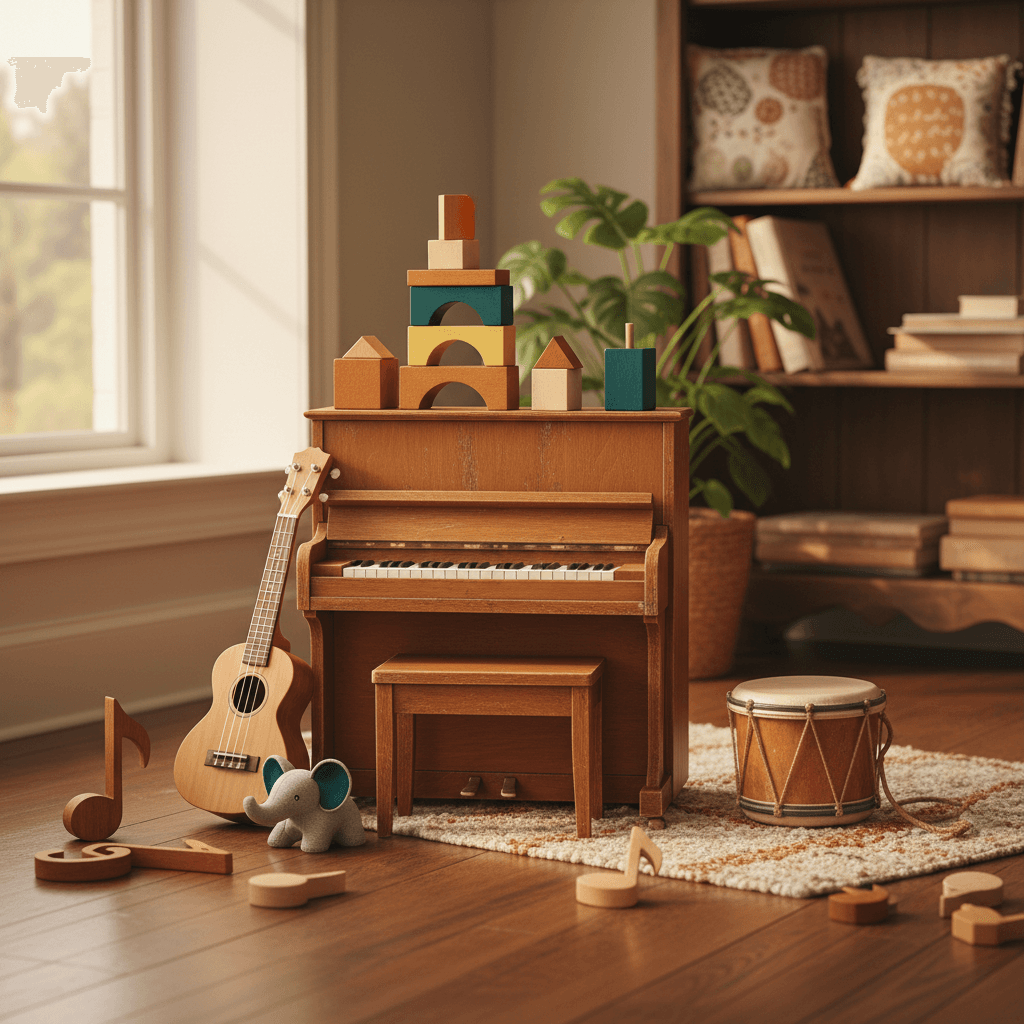
Piano Lessons for Three Year Olds: A Step-by-Step Guide for Parents
Discover how to start piano lessons with your 3-year-old using play-based methods, age-appropriate curricula, and practical tips for joyful home practice.
Three year olds can absolutely begin piano lessons when teaching is shaped around how they actually learn. Short, playful sessions built on movement, games, and exploration match their developing attention spans and motor skills, laying a genuine musical foundation while keeping curiosity and joy at the centre of every lesson.
Is Your Three Year Old Ready for Piano? What Developmental Science Tells Us
Research shows that the brain's auditory cortex develops most rapidly between ages 2 and 7, making early musical exposure one of the most impactful investments a parent can make. By age 3, many children already hum melodies, tap rhythms, and respond physically to music, signs that meaningful piano learning is genuinely within reach. Understanding the developmental science behind that window helps parents approach the decision with confidence rather than competition.
What cognitive and motor milestones make piano learning possible at age three
Bilateral hand coordination begins emerging around age 3, and while independent finger isolation is still developing, the piano keyboard offers a beautifully simple, cause-and-effect interface a toddler can operate independently. Pressing a key produces a sound every single time, a satisfying step that rewards curiosity immediately. Neuroscientists use the term "sensitive period" to describe this phase of accelerated musical learning. Fine motor readiness does not need to be complete before lessons begin; the gentle, playful demands of early piano study actually help accelerate those very skills in a low-pressure way.
How does a toddler's attention span shape the ideal lesson structure?
Most 3-year-olds have a functional attention span of 6 to 10 minutes per task, which shapes every aspect of lesson design. A skilled teacher rotates through what early childhood educators call "micro-activities" every 5 to 7 minutes, keeping energy fresh and engagement high throughout the session. Time spent on any single task is brief by design. For more on structuring piano lessons for a 3-year-old, see how one experienced teacher built a workable framework around these natural attention rhythms. You can also explore toddler piano lessons in Newfoundland for locally relevant context.
Signs your child is showing musical curiosity worth nurturing
You do not need to see every sign on this list before starting lessons. Even two or three of the following behaviours suggest a child whose musical curiosity is ready to be channelled:
- Hums or sings spontaneously throughout the day, even without prompting
- Taps rhythms on surfaces, furniture, or their own body while playing
- Asks to touch a piano, keyboard, or other instrument when they see one
- Responds to music with physical movement: swaying, bouncing, or dancing
- Mimics songs they have heard, attempting the correct melody and words
- Shows genuine interest in the sounds around them and where those sounds come from
These musical behaviours reflect the brain's natural drive to engage with sound and pattern. A child who shows this kind of curiosity is not just ready for music; they are already doing it in their own way.
What Do Piano Lessons for Three Year Olds Actually Look Like?
Picture a 3-year-old named Lily sitting at a small keyboard, not reading sheet music, but gleefully pressing a key every time her teacher sings "elephant stomp." That single playful exchange is teaching her steady beat, cause-and-effect, and listening skills all at once, and she thinks it's a game. This is what thoughtfully designed early childhood piano instruction looks like from the inside, and it is a very long way from a child sitting rigidly at a bench drilling scales.
How long should a piano lesson be for a toddler?
A well-designed piano lesson for kids for a toddler runs 20 to 30 minutes, shorter than adult or even school-age lessons for clear developmental reasons. Forty-five-minute or hour-long lessons are not appropriate for this age group; the child's attention and energy simply cannot sustain them productively. Within that 20 to 30-minute window, the teacher adjusts pacing in real time based on the child's mood and energy on that particular day. Shorter does not mean less valuable. A focused, joyful 25-minute session will accomplish far more than a dragged-out hour that ends in tears.
Play-based learning: why games and exploration come before technique
Constructivist early childhood education has long established that children learn best through active exploration rather than passive instruction. In piano pedagogy, this principle is called play-based pedagogy, and it means that games and discovery activities come before formal technique. A child learns pattern, rhythm, and pitch through musical games long before they can name a note or curve their fingers correctly. The preschool piano curriculum for ages 3–6 at Wonderkeys is one well-known example of this philosophy made concrete. Playing simple musical games is intentional, rigorous pedagogy, not a soft substitute for real learning. Technique, including hand position and finger curve, is introduced gently and gradually once the child is ready.
The role of music and movement in a preschool piano session
Movement is how toddlers encode rhythm and pulse in the body before transferring it to an instrument. A Dalcroze-influenced approach, widely used in early childhood music education, places clapping, marching, and swaying before the child ever sits at the keys. When a child has physically felt a steady beat by stomping her feet or swinging her arms, playing it at the piano becomes a natural next step rather than an abstract instruction. The sounds she produces connect to a felt, whole-body experience. This integration of movement and music is not warm-up filler; it is the foundation on which real piano skill is built.
Group music classes versus private lessons for young children
Both formats offer genuine value, and the right choice depends on your child's temperament and your family's goals:
- Private lessons offer individual pacing and undivided teacher attention, ideal for focused or shy children
- Group classes provide social musical play and the motivation of peer engagement
- Group settings typically cost less per session than private instruction
- Private lessons allow the teacher to follow a single child's energy and readiness closely
- Some children thrive starting in a class before transitioning to private lessons as their attention grows
Explore preschool music lessons in Newfoundland for a closer look at both formats available locally.
Building Blocks of a Preschool Piano Curriculum
What does a child of 3 actually need to learn at the piano, and what can safely wait until they are older? The answer shapes everything: which method books a teacher chooses, how a lesson is paced, and whether a child leaves each session smiling or overwhelmed. A well-sequenced curriculum respects where a 3-year-old genuinely is, rather than where a teacher might wish they were.
Matching the piano method to where a three year old truly is developmentally
Not all method books are designed with pre-readers in mind, and placing a toddler in a curriculum built for a 7-year-old is a reliable recipe for frustration. A skilled piano teacher selects resources based on each individual student's literacy level, attention capacity, and motor readiness. Curricula like Wonderkeys are specifically scaffolded for ages 3 to 6, building concepts one step at a time without assuming prior reading ability. A developmentally mismatched method book does not just slow progress; it can undermine a child's confidence at the very moment it should be growing.
| Curriculum Area | What It Looks Like at Age 3 | When It's Introduced |
|---|---|---|
| Steady beat | Clapping, tapping, marching | First lesson |
| High and low pitch | Vocal play, keyboard exploration | Weeks 1 to 2 |
| Landmark notes | Middle C, black key groups | Weeks 4 to 8 |
| Finger placement | One finger at a time, index or thumb first | Weeks 2 to 4 |
| Simple rhythm patterns | Short, repetitive song phrases | Weeks 3 to 6 |
| Staff notation | Not introduced at this stage | Age 5 to 6+ |
What a beginner lesson includes: songs, rhythmic activities, and first finger placement
A sample lesson arc for a 3-year-old might look like this: a greeting song to settle and focus the children, a rhythmic clapping game to internalize pulse, free exploration at the keys to develop comfort with the instrument, one focused note or finger activity targeting a single concept, and a closing song to end on a warm, successful feeling. Within 4 to 8 weeks, most toddlers can identify landmark notes like Middle C and the groups of black keys. The piano begins to feel like a familiar friend rather than a strange piece of furniture, and that familiarity is what makes further lesson content land.
How early music theory is introduced through listening and play rather than notation
Pre-readers cannot process staff notation, and asking them to do so creates unnecessary anxiety. Instead, early theory is taught aurally and kinaesthetically. Learning to distinguish high from low, loud from soft, fast from slow, and same from different pattern builds a strong musical ear long before a note is placed on a staff. Sound itself becomes the text. Free printable piano games for preschool learners from Vibrant Music Teaching offer practical, ready-made resources that make this approach easy to implement. Reading notation typically emerges naturally around ages 5 to 6. Aural-first teaching is not a shortcut; it is the pedagogically sound sequence that professional early childhood music educators use worldwide.
The Benefits of Starting Piano Lessons Early
Starting piano before kindergarten does not make a child a prodigy, but it does give their developing brain a remarkably rich set of tools that extend far beyond music. The research on early musical training and cognitive development is some of the most compelling in childhood education, and parents who understand it can feel genuinely confident in the investment they are making.
Language development and how musical training supports it
Language development and musical training share deep neurological roots. Phonological awareness, the ability to hear and manipulate the sounds within words, is strengthened through rhyme, rhythm, and pitch discrimination, all of which are built into singing simple songs at the piano. Vocabulary grows naturally through the storytelling embedded in music and song lyrics. Children who engage in early musical learning tend to develop stronger rhyme recognition and syllable mapping skills, both of which directly support reading readiness. For parents, this is a joyful side benefit: your child is not just starting piano; they are building the cognitive scaffolding for literacy.
How piano learning builds confidence and emotional expression in young children
Every time a young child presses a key and produces a sound intentionally, they experience genuine agency. That moment, small as it seems, is a meaningful confidence builder. Performing a short piece for family and friends offers a safe, low-stakes experience of being heard and celebrated. A look at a real-world toddler piano lesson approach shows how these small performances are woven naturally into early music programs. Musical vocabulary also grows when children associate sounds with feelings: a bouncy song feels happy, a slow song feels calm. This emotional fluency develops quietly alongside technical skill, and parents often notice it first at home.
Creative thinking, fine motor skills, and the long-term love of music
Playing the piano requires both hands to work independently, engaging both hemispheres of the brain simultaneously. For kids, this bilateral fine motor practice builds small-muscle coordination in a genuinely enjoyable context. Improvisation games and sound exploration develop creative thinking: a child who makes up a "thunder story" at the keyboard is problem-solving, narrating, and experimenting all at once. Each step from curiosity to confidence to creativity is most sustainable when early lessons remain joyful rather than perfectionistic. Children who associate their first musical experiences with warmth and play are far more likely to continue into formal study. Read our full guide to piano lessons for 3-year-olds for additional depth on supporting that long-term love.
How Parents Can Support Practice and Progress at Home
Supporting your child's piano practice at home is less like supervising homework and more like tending a small garden: your job is to create the right conditions, a warm space, a little daily water, and patience, and then let the growth happen on its own terms. The research on early childhood learning consistently shows that consistency and positive association matter far more than duration or intensity.
What does healthy, joyful daily practice look like for a three year old?
Ideal home practice for a 3-year-old is just 5 to 10 minutes, ideally at the same time each day so it becomes a comfortable routine rather than a negotiation. There is no need to "get it right"; the goal is a warm, brief encounter with the instrument. Let your child return to songs they already love. Sit nearby so they feel supported, but resist the urge to direct. Ending each session on a success, even something as small as finding Middle C once, builds a positive association with the piano that carries forward into every future lesson.
Simple at-home piano activities that feel like playtime
These four activities require no music-reading ability from parents and feel like play to a 3-year-old:
- Echo games: You play a simple two or three-note phrase; your child copies it back. This trains listening and sound matching without any formal instruction.
- Find the black keys: Ask your kids to find all the groups of two black keys, then all the groups of three. Turn it into a counting game with a small celebration each time.
- Sing the lesson song together: Singing the song from this week's lesson reinforces pitch and rhythm in a naturally joyful way.
- Sound story: Invite your child to make up a short story at the keyboard using high notes, low notes, loud and soft. Their imagination does the work.
For music activities that work across early childhood, you will find additional ideas that complement home piano exploration beautifully.
How to encourage without adding pressure during the early stages
Parents play a more powerful role in a child's musical development than they often realise, and the most important thing they can do is remove pressure rather than add it. Avoid comparisons to other children; every young learner's path is different. Praise effort and curiosity rather than output: "I loved watching you explore those keys" lands better than "you played that wrong." A 3-year-old who feels safe is far more likely to start again tomorrow. If your child resists on a particular day, gentle redirection works far better than insistence. The teaching of early piano is the teacher's responsibility; your role at home is simply to keep the environment warm, safe, and free from judgment.
Finding the Right Piano Teacher or Program in Newfoundland
Music education in Newfoundland has deep community roots, from kitchen sessions to school choir programs, and today that tradition continues through a growing network of private music teachers and small-group programs serving families across the Avalon Peninsula, including those with children as young as 3. Families here do not need to search far to find quality early childhood music instruction.
What qualities should you look for in a piano teacher for a toddler?
The most important quality in a piano teacher for a 3-year-old is specific experience with early childhood, not just general piano teaching. Ask whether they use play-based methods and whether they are familiar with age-appropriate curricula designed for pre-readers. Observe their warmth and patience during a trial lesson; these qualities are visible within the first few minutes. A teacher who understands where young children genuinely are developmentally will shape music learning as a joy rather than a demand. Do not hesitate to ask about their approach before committing to ongoing lessons.
Private lessons, small-group classes, and community music programs across the Avalon
Newfoundland families on the Avalon Peninsula have access to three main formats for early piano and music education. Private lessons offer individual pacing and close teacher attention, ideal for children who need a gentler, more personal introduction. Small-group class settings bring kids together for shared musical play, which builds social confidence alongside musical skills. Community workshops offer a low-commitment entry point for families who want to explore before committing. Families outside major centres sometimes assume they need to travel to a larger city like Toronto for quality early childhood music instruction, but strong local options exist right here on the Avalon. Discover piano and voice lessons near you in Newfoundland to explore what is available in your area.
What to expect when you contact a local music educator for the first time
Reaching out to a local piano lessons for children provider for the first time is a low-pressure process. Most educators offering piano lessons for children at this age will begin with a short discovery conversation, either by phone or email, to understand your child's age, temperament, and any prior musical experience. Many offer a trial lesson so your child can meet the teacher and experience the environment before any commitment is made. Come prepared with a few simple observations about your child: what music they respond to, how long they typically focus on a single activity, and whether they have had any exposure to instruments. A good teacher will take it from there, meeting your child exactly where they are. You can learn more about what to expect from lessons at Madison Curtis, your local Newfoundland music educator serving families across the Avalon.
Key takeaways
- A 3-year-old's natural attention span of 6 to 10 minutes per task means lessons should be 20 to 30 minutes long, with activities rotating every 5 to 7 minutes.
- Play-based pedagogy, using games, movement, and sound exploration, is the developmentally appropriate foundation for early piano learning, not a compromise.
- Early piano study supports language development, fine motor coordination, emotional expression, and creative thinking well beyond music itself.
- Home practice of just 5 to 10 minutes daily, kept joyful and pressure-free, is more valuable than longer, tense sessions.
- When choosing a teacher in Newfoundland, look specifically for early childhood experience, warmth, and familiarity with pre-reader piano curricula.
FAQ
At what age can a child truly start piano lessons?
Most children are developmentally ready for structured, play-based piano lessons between ages 3 and 4. Key readiness signs include:
- The ability to follow simple two-step instructions
- Showing interest in music through humming, tapping, or asking to touch instruments
- A functional attention span of at least 5 to 6 minutes
Formal notation and technique are not required at this stage; a good teacher works entirely through play and listening at first.
How long should piano lessons be for a 3-year-old?
A 20 to 30-minute lesson is the appropriate length for a toddler. This matches their natural attention window and allows for 3 to 4 brief activity rotations within a single session. Longer lessons are not more valuable at this age; they tend to result in fatigue and negative associations with the instrument. Consistency across short sessions is far more effective than occasional longer ones.
Do parents need to know how to play piano to support their child at home?
No musical background is needed. Parents support their child best by:
- Sitting nearby during the 5 to 10-minute daily practice session
- Singing along to the lesson songs together
- Playing simple echo or exploration games at the keyboard
- Keeping the environment warm and free from pressure
The teacher provides all the musical instruction; parents provide emotional safety and routine.
What is the difference between a play-based piano method and a traditional one?
A play-based piano method uses games, movement, stories, and exploration to teach musical concepts before introducing notation or formal technique. Traditional method books often assume a child can read or follow written exercises, which is not appropriate for ages 3 to 4. Play-based curricula like Wonderkeys are specifically designed for pre-readers and sequence concepts carefully so that children build genuine musical understanding through joyful activity rather than repetitive drilling.
Is a group class or private lesson better for a 3-year-old?
Both formats work well depending on the child's temperament. Group classes offer social engagement, peer musical play, and are often more affordable. Private lessons provide individual pacing and closer teacher attention. Some families find that a community group class is a gentle first step, transitioning to private lessons once the child is comfortable. There is no single right answer; the best choice is the one that keeps your child engaged, relaxed, and excited to come back.