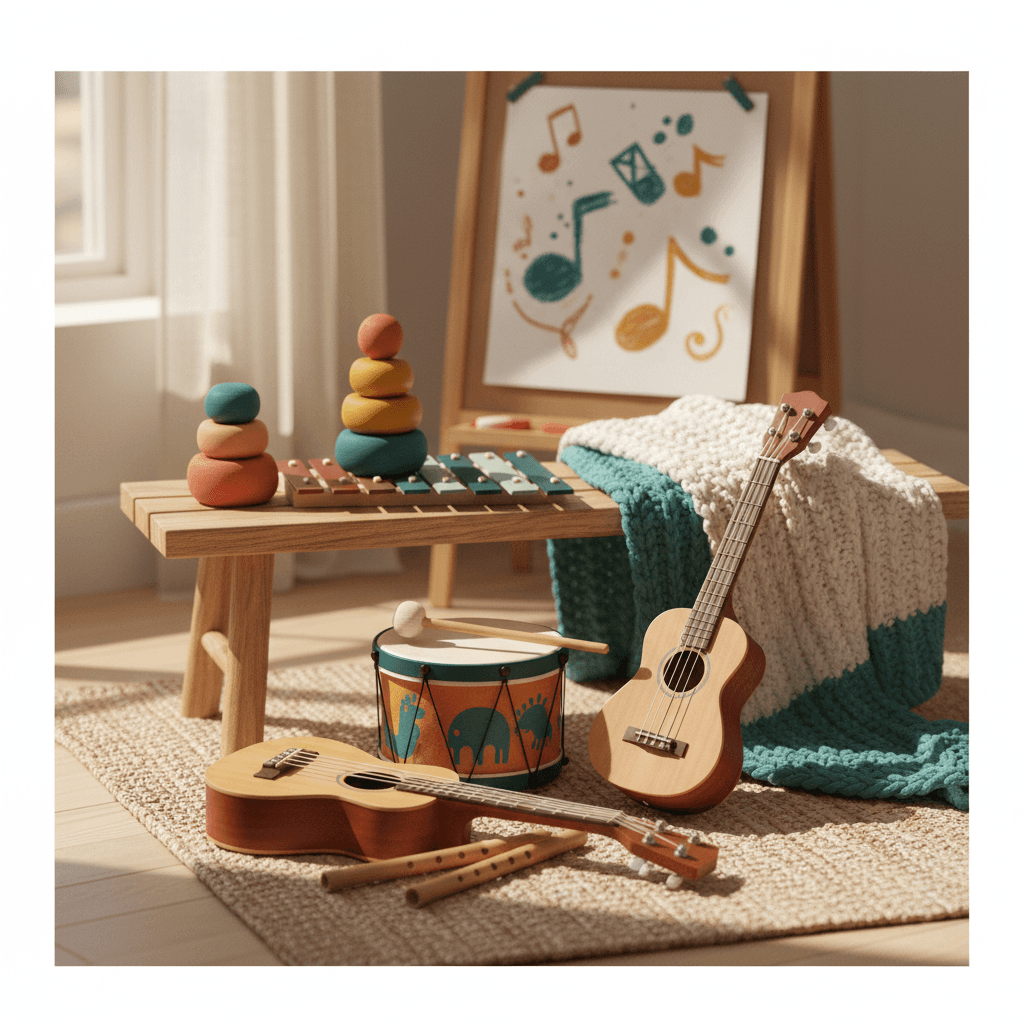
Kindergarten Music Lessons: Activities, Lesson Plans, and What to Expect
Discover how kindergarten music lessons build skills through play, singing, and rhythm. Get lesson plan ideas and tips to support your child at home.
Kindergarten music lessons give children ages 4 to 6 a structured, playful way to develop listening skills, steady beat, and vocal confidence during one of the brain's most receptive windows for musical learning. Through singing, movement, and simple instruments, young learners build cognitive, motor, and social foundations that support them well beyond the music room.
Why Music Education Matters for Kindergarten-Age Children
Research from the National Center for Biotechnology Information documents measurable phonological awareness gains in children who receive music lessons during early childhood. Between ages 4 and 6, the brain is forming auditory processing pathways at remarkable speed, and structured instruction provides stimulus that reinforces language acquisition, fine motor control, and emotional regulation simultaneously. This is not an extracurricular add-on. It is a cognitive and social investment supported by peer-reviewed evidence, one that pays dividends across reading, numeracy, and peer relationships long after the singing circle ends.
How does music learning support cognitive and motor skill development in young children?
Clapping a steady beat and tapping rhythms on knees engage bilateral coordination, training both sides of the body to work in sync. Memorising a song activates working memory in ways that overlap directly with early literacy skills. Movement-based musical activities reinforce proprioception and gross motor sequencing. If you are curious about what early music readiness looks like before kindergarten begins, the guide on preschool music lessons in Newfoundland offers a helpful starting point for families with younger children.
The social benefits of music class for children aged 4–6
Circle-time singing builds turn-taking naturally: one child leads, the group echoes, and everyone waits. Call-and-response games teach active listening in a way few other classroom formats can match. A group of 4 to 8 children sharing a common pulse learns empathy through synchrony, feeling what it means to be in time with another person. Madison Curtis's small-group classes across the Avalon Peninsula intentionally mirror kindergarten classroom dynamics, so children arrive at school already practised in collaborative, attentive participation.
What makes kindergarten the ideal starting point for music education?
Ages 5 and 6 sit inside the sensitive period for tonal and rhythmic imprinting. Children at this level absorb melodic pattern and pulse intuitively, without needing formal notation. Waiting until age 8 or 9 means missing years of natural auditory receptivity. Ear-first learning is developmentally appropriate here, and it is where every strong curriculum begins. For a fuller picture, see what parents need to know about music lessons for kindergarteners.
How Young Children Actually Learn Music (And How Good Lessons Reflect That)
Think of a kindergartener's attention span the way you think of a candle in a breeze: warm and bright, but easily shifted. A well-designed music classroom works with that flicker rather than against it, cycling through short bursts of singing, movement, listening, and play so the flame stays lit from first note to last. Teachers College Columbia University's early childhood music research confirms that sensorimotor and imitative learning dominate ages 3 to 7, meaning children learn by doing and copying before they learn by analysing.
Developmental stages that shape kindergarten music curriculum
Edwin Gordon's Music Learning Theory describes a pre-tonal and early tonal sequence in which children between ages 4 and 7 are in an "audiation babble" window, absorbing tonal patterns and metre before they can label them. Teaching music at this stage means prioritising simple duple and triple metres, short melodic motives, and rote song learning well before any notation is introduced. Song before symbol is not a shortcut; it is the correct pedagogical sequence, mirroring the way children learn spoken language by hearing words long before reading letters.
Why short, varied activities work better than long structured drills
- A typical kindergartener sustains focused attention for 5 to 10 minutes per activity before cognitive load peaks.
- Transition cues (a signal chord, a clap pattern) reduce anxiety and help children shift smoothly between tasks.
- Multi-sensory reinforcement, singing then moving then playing, consolidates the same concept through different pathways.
- Fun music formats keep motivation high, which is itself a learning variable at this age.
- Variety prevents habituation, keeping each concept feeling fresh rather than repetitive.
The role of play, repetition, and imagination in early music education
Repetition in songs builds internal ear maps that children draw on long after the session ends. Hearing the same melodic phrase ten times across a week is not boredom; it is consolidation. Play-based framing lowers performance anxiety so kids can take musical risks freely. Imaginative scenarios link abstract pitch concepts to embodied experience: "We're birds flying high, so let's sing way up here" makes the idea of a high note concrete and memorable. Drawing on ideas from international research into early childhood pedagogy, experienced educators weave repetition and imagination together so each lesson teaches without feeling like a drill.
How a skilled music teacher reads and responds to a kindergartener's energy
A responsive music teacher notices when a student's posture signals restlessness and slows the tempo, switches from sitting to standing, or drops to a quieter dynamic to draw attention back in. Every day brings a different energy into the room, and lesson planning must remain flexible enough to meet it. Skilled teaching at this level is less about following a script and more about reading the room moment to moment.
Core Elements of an Engaging Kindergarten Music Lesson Plan
What does a great kindergarten music lesson actually contain, and how can you tell a thoughtfully designed class from one that's just organised chaos? The answer lies in five building blocks that every strong music classroom returns to, regardless of instrument, style, or group size. The 2019 California Arts Standards document how these elements align with broader K–12 music frameworks across North America.
| Lesson Component | Purpose | Approximate Time | Example Activity |
|---|---|---|---|
| Greeting Song | Belonging, focus, name recognition | 3–5 min | Name-echo call-and-response |
| Steady Beat Activity | Pulse internalisation | 5 min | Clapping to a nursery rhyme |
| Vocal Exploration | Pitch range, breath control | 5 min | High/low siren slides |
| Body Percussion / Movement | Kinesthetic rhythm learning | 7–8 min | Four-beat stomp-clap pattern |
| Closing / Reflection | Ritual, memory consolidation | 3–5 min | Farewell song with gestures |
Steady beat and rhythm: the foundation of every music activity
Steady beat is a constant, unwavering pulse. Rhythm is the pattern of long and short sounds that sits on top of that pulse. Beat competency must come first; without it, rhythmic patterns have no anchor. Even clapping along to a children's song while walking to preschool and kindergarten is valid beat training for a five-year-old. Research consistently shows that beat competency in early grades predicts stronger rhythmic literacy by 1st grade, making it the single most important foundational skill in the kindergarten curriculum.
Singing and vocal exploration in the early years
Kindergarteners are still developing their singing voice, with a comfortable range sitting roughly around D4 to A4. Exploration matters more than polish at this stage. Encouraging pitch slides, animal sounds, and echo phrases builds the internal ear without placing pressure on volume or precision. Voice lessons for kids in Newfoundland offers more detail on age-appropriate vocal care and development for young singers.
Body percussion and movement activities that anchor musical concepts
Clapping, patting, stomping, and snapping give kinesthetic learners a concrete entry point to abstract musical ideas. Two well-established pedagogical frameworks, Orff Schulwerk and Dalcroze Eurhythmics, both place body movement at the centre of early music education for exactly this reason. A simple four-beat body-percussion sequence tied to a familiar nursery rhyme, pat-pat-clap-rest, gives children a physical experience of metre they can feel before they can name it.
Listening activities that build a musical ear without overwhelming young learners
Short listening excerpts of 60 to 90 seconds, followed by a guided movement or drawing response, introduce concepts like loud and soft, fast and slow, and high and low in an accessible way. Asking a child to tiptoe when the music is quiet or stomp when it is loud keeps bodies engaged and removes the expectation of passive, chair-bound listening that is developmentally inappropriate for this elementary school age group.
What does a well-structured kindergarten music lesson look like from start to finish?
- Greeting song with names: the music teacher sings each child's name; the group echoes, establishing belonging and focus.
- Steady-beat clapping activity: clapping to a familiar song while walking or rocking internalises the pulse physically.
- Vocal exploration exercise: pitch slides or animal-sound play warms the voice without pressure.
- Body percussion or movement sequence: a four-beat pattern reinforces metre through the whole body.
- Short listening moment with response: a 60-second excerpt paired with a movement prompt builds the musical ear actively.
- Closing song and farewell ritual: a consistent closing song signals transition and helps students leave with a sense of completion.
Fun Music Activities That Work Beautifully With This Age Group
One kindergarten student walked into class convinced she couldn't sing. By the end of the first circle-time call-and-response game, she was leading the whole group through a four-note echo, grinning the entire time. The right activities don't just teach popular music; they rebuild a child's confidence in her own musical voice. International research into early childhood music practices confirms that participatory, culture-rooted activities consistently outperform passive instruction for this age group.
5 Music Activity Ideas for Kindergarteners:
- Name-echo greeting song
- Freeze-and-move steady-beat game
- Shaker rhythm matching
- Picture-book soundscape
- Animal-sound vocal exploration
Circle time songs and call-and-response games
Call-and-response is one of the oldest teaching tools in human culture, present in African, Indigenous Canadian, and folk traditions across centuries. For a kindergarten class, four-beat phrases give children just enough time to absorb the call and prepare their echo. Active participation replaces passive listening, and rhythmic internalisation happens almost without the child noticing it is a lesson at all.
Simple instrument exploration: shakers, hand drums, and classroom percussion
No formal technique is required at the kindergarten level. The goal is matching a steady rhythm, taking turns, and noticing dynamics: when do we play loud, and when do we play soft? Orff instruments including hand drums and small xylophones are classroom staples precisely because they are intuitive enough for a five-year-old to engage with meaningfully on day one. The focus remains entirely on what happens inside the lesson, not on any equipment a family needs to source.
Storytelling through music: pairing picture books with sound
Choose a picture book with a strong narrative arc, then assign a recurring sound to a key character or event. Children play or vocalise on cue as the story unfolds. A rainstorm scene scored with shakers and finger-snaps integrates reading and school music naturally, making both feel richer. This format supports literacy goals and musical ones simultaneously, which makes it a favourite in mixed-skill groups.
Private Lessons vs. Group Music Classes for Kindergarteners: Which Fits Best?
The "private lessons are always better" assumption that many parents carry into their first conversation with a music teacher does not hold at kindergarten age, and understanding why can save families both money and frustration.
| Factor | Private Lessons | Group Classes |
|---|---|---|
| Attention to individual child | High | Moderate |
| Social skill-building | Limited | Strong |
| Recommended class length | 20–30 minutes | 30–45 minutes |
| Best for shy learners | Yes, initially | With time, very beneficial |
| Best for social learners | Can feel isolating | Excellent fit |
| Cost range (relative) | Higher per session | Lower per session |
What can a child realistically learn in one-on-one music lessons at age 5?
A five-year-old in private lessons can learn beginning piano hand position, simple songs by ear, steady beat, and basic vocal pitch matching within the first few months. Expectations should remain warm and realistic: progress is measured in engagement and comfort, not technical output. For context on what music learning looks like at an even younger age, see our guide on piano lessons for young learners before booking.
How small-group music classes build confidence alongside skills
Social learning theory shows that children imitate peers, take safe risks in groups, and celebrate each other's small victories in ways that private settings rarely replicate. A group of 4 to 6 children creates low-stakes performance experience every single lesson, so by the time a student reaches grade 1 music, performing in front of others feels familiar rather than frightening. Madison Curtis's group format across the Avalon Peninsula is designed with exactly this developmental arc in mind.
What should parents look for when choosing a music teacher for a young child?
- Experience with early-childhood pedagogy and developmentally appropriate practice
- Use of play-based, movement-centred methods rather than notation-first drilling
- A warm, patient classroom manner that makes children feel safe to try and fail
- Structured lesson plans that remain flexible enough to follow a child's energy on a given day
- Clear, regular communication with parents about progress and home reinforcement ideas
- Working knowledge of child voice development and fine motor limitations at elementary school age
Supporting Your Kindergartener's Music Learning at Home
Long before formal music schools existed, children learned music the way all folk traditions were passed down: through daily singing, listening, and playful imitation inside the home. That everyday musical environment remains one of the most powerful supports a parent can offer a young learner today. Parental involvement correlates strongly with sustained music engagement, and the good news is that meaningful support requires no musical training whatsoever.
How much practice is realistic and helpful for a five-year-old?
Five to 10 minutes of fun music play each day is more valuable than a single forced 30-minute session once a week. Singing in the car, clapping the beat of a favourite song at dinner, or doing a quick echo-clap game before bed all count. Aim for 3 to 4 familiar songs repeated across the week; that repetition is how the internal ear map gets built, gently and without stress.
Simple ways parents can reinforce music activities between lessons
- Sing nursery rhymes at bedtime to reinforce tonal patterns and language rhythm together.
- Clap the beat of a favourite song and invite your child to join in.
- Play "echo my clap" for two minutes: you clap a short pattern, they copy it back.
- Listen to a short piece of music together and describe what you hear: fast or slow, high or low.
- Check the notes your music teacher posts after class and try one suggested activity during the week.
- Leave a comment or question for the teacher between sessions so adjustments can be made quickly.
Understanding how music teachers prepare students and communicate progress can also help parents know what to expect and how to stay constructively involved.
Key Takeaways
- Kindergarten, ages 4 to 6, is a developmentally well-supported window to begin music lessons, particularly through ear-first, play-based learning rooted in the sensitive period for tonal and rhythmic imprinting.
- Steady beat and vocal exploration are the two most foundational skills to build first, before rhythm complexity or notation is introduced.
- Short, varied activities of 5 to 10 minutes each are more effective than long drills for this age group, matching the typical kindergartener's sustained-focus window.
- Both private lessons and small-group classes offer genuine value; the best format depends on a child's temperament, social readiness, and learning goals.
- Parents can support learning meaningfully at home through daily musical play, singing familiar songs, and staying in regular communication with the teacher.
FAQ
What is popular music learning for kindergarteners, and how does it differ from classical approaches?
Popular music learning at kindergarten age simply means using familiar, contemporary children's songs as the vehicle for teaching music, rather than classical repertoire. Both approaches develop the same foundational skills. The key difference is engagement: children respond more readily to songs they recognise. Most skilled early-childhood educators blend both, using whatever captures a child's attention most effectively.
How do I know if my child is ready for school music lessons at age 5?
Readiness signs include:
- Showing interest in singing or moving to music spontaneously
- Able to sit and engage in a focused activity for 5 to 10 minutes
- Comfortable in a small-group or one-on-one setting with an adult
- Responsive to simple instructions and eager to try new things
Formal readiness tests are rarely needed. If a child enjoys music at home, lessons are likely to be a positive experience.
What is Music Play Online and is it useful for kindergarteners?
Music Play Online is a digital resource platform designed to support early childhood school music educators with songs, activities, and lesson materials grounded in Music Learning Theory. It can be a useful supplementary tool for teachers planning preschool and kindergarten curriculum, though it works best alongside live, relational instruction rather than as a standalone replacement for in-person lessons with a qualified teacher.
What should a grade 1 music or kindergarten lesson plan include?
A strong lesson plan for kindergarten or elementary school Grade 1 should include a greeting song, a steady-beat activity, vocal exploration, body percussion or movement, a short listening moment, and a closing ritual. Each segment should run approximately 5 minutes, fitting within a 30-minute session. Variety across modalities, singing, moving, listening, playing, is the structural key to keeping young learners engaged throughout.
How does teaching music in small groups differ from one-on-one lessons for this age?
In small groups of 4 to 8 children, learning is social and imitative: children watch peers, take turns, and build confidence through shared participation. One-on-one lessons allow a teacher to tailor every moment to a single child's pace and temperament. Neither format is universally superior; many families find that starting with group classes and adding private lessons later as skills develop is a practical and effective sequence.