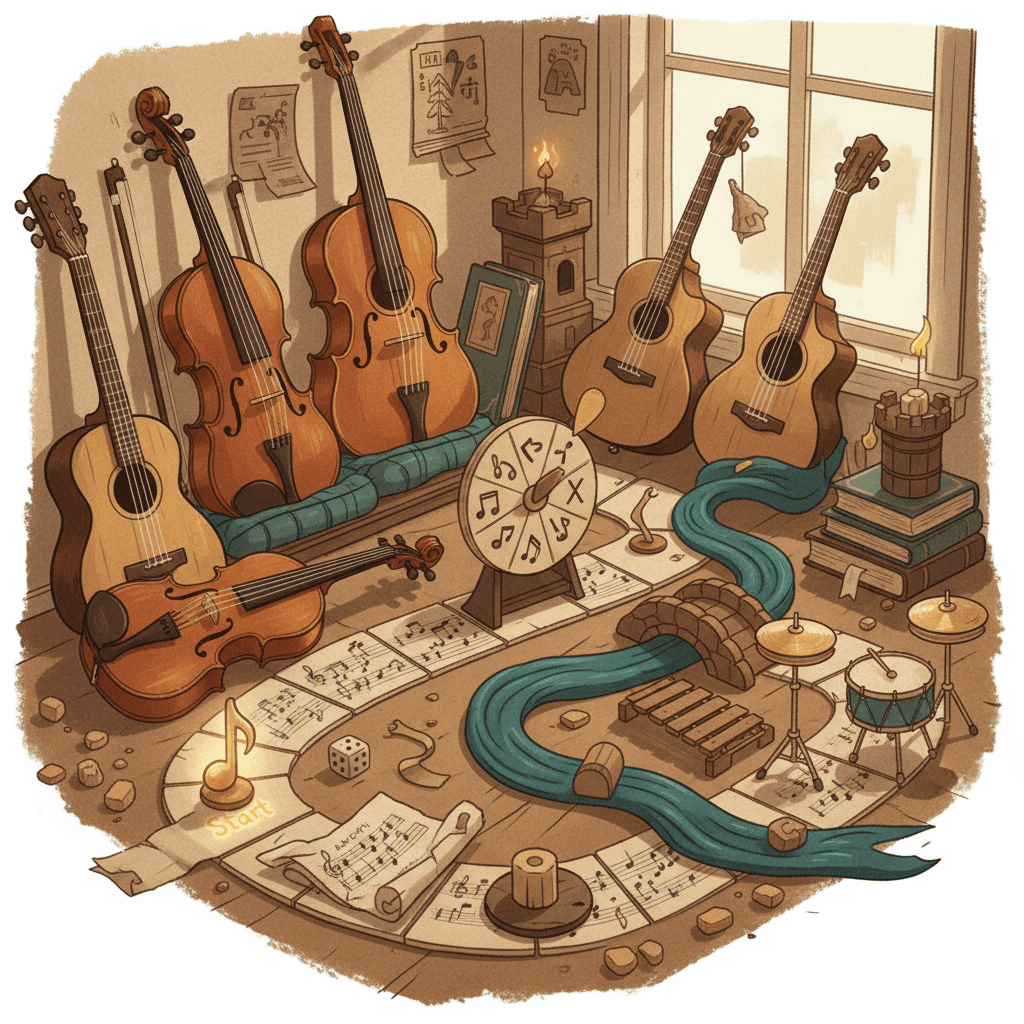
Fun Music Teacher Games That Actually Teach: Rhythm, Theory, and Ear Training
Discover music teacher games that build real skills in rhythm, theory, and ear training. Practical ideas for every age, from first lesson to middle school.
Music teacher games are not just fun fillers; they are structured learning tools that build rhythm recognition, note-reading fluency, and ear training through active play. Whether you teach a five-year-old beginner or a twelve-year-old advancing student, the right game turns abstract music concepts into concrete, memorable skills.
Why Games Belong in Your Music Lessons (Not Just as a Reward)
Games are not the dessert at the end of a music lesson. They are the lesson. When a student races a classmate to name a treble clef note or claps back a rhythm pattern, real musical memory is forming. Treating games as a treat undermines exactly the learning tool that makes theory stick.
How play-based learning builds genuine musical skills
Musical skills develop in layers, and each layer benefits from active repetition rather than passive observation. When kids play rhythm games, they engage the same motor pathways that structured drill activates, which means they learn the skill just as thoroughly while enjoying the process far more. Sign languages, flashcards, and note-identification games all build the automaticity that lets a student eventually read music without conscious effort. As a parent, you can trust that when your child looks like they are simply playing, genuine musical learning is happening at the same time.
What the research says about games and music memory retention
The research supports game-based music learning clearly: children aged 5 to 10 retain procedural skills meaningfully better through game-based repetition than through rote drill alone. This aligns with the National Core Arts Standards, which emphasise creative engagement alongside technical accuracy. Music memory retention simply means how reliably a student can recall and apply a skill under pressure, and games are among the most effective ways to build that reliability in a warm, low-stakes setting.
Matching game types to developmental stages in young learners
Choosing the right game for the right age matters enormously. Here is a quick guide:
- Ages 3 to 5: Simple echo and movement games; explore preschool music lessons in Newfoundland for age-appropriate activities that match this stage.
- Ages 6 to 8: Rule-based games become accessible around age 7, per Jean Piaget's developmental stages; note-name bingo and clapping circles are ideal. See kindergarten music activities for structured ideas.
- Ages 9 to 12: Students can handle timed flashcard races, interval challenges, and multi-step rhythm games.
- Ages 13 and up: Abstract composition and improvisation games that reward creative agency work best with teenage students.
Rhythm Games Every Music Teacher Should Know
Picture a room of eight-year-olds who have just been told to count quarter notes on the page. Blank stares. Now ask them to clap that same rhythm back to you in a copycat circle and every hand flies up. That shift from passive reading to active doing is exactly what rhythm games accomplish in sixty seconds flat.
Body percussion circles: clapping quarter notes and beyond
Body percussion circles are one of the most accessible rhythm games available, requiring zero equipment. Here is a simple four-step setup:
- Form a circle so every student can see and hear each other.
- The teacher sets a steady beat by clapping or patting knees.
- Students mirror the pattern, locking in together before adding variation.
- Introduce eighth note subdivisions by doubling the clap speed on one beat.
Five body-percussion patterns worth practising:
- Clap, clap, pat (quarter, quarter, quarter rest)
- Clap-clap, pat, pat (two eighths, two quarters)
- Snap, clap, stamp, clap
- Pat-pat, clap, rest, clap
- Alternating hand claps with a spoken "ta" on each beat
Check out interactive rhythm activities for primary classrooms for more pattern ideas beyond quarter notes.
Rhythm copycat: call-and-response for elementary music classes
The call-and-response mechanic is beautifully simple: the teacher claps a two-bar rhythm game pattern and students echo it straight back. Rooted in the Kodály method, which has been guiding music educators since the 1950s, this approach works with voice, clapping, or any rhythm instrument you have on hand. It scales effortlessly from a lesson with two kids to a group of twenty, making it one of the most versatile tools in any teacher's toolkit.
Beat-the-teacher: a quick warm-up game for any instrument lesson
Beat-the-teacher flips the usual dynamic in a delightful way. The teacher plays or claps a familiar rhythm, but deliberately slips in a mistake. The student's job is to catch it. This reversal focuses attention sharply because kids love catching a teacher in an error. It fits comfortably into the first five minutes of a 30- or 45-minute lesson and works equally well on piano, ukulele, guitar, and voice. The game rewards active listening rather than passive waiting, which is exactly the habit you want students to build early.
Can rhythm games replace traditional drills for young students?
Games complement drills; they do not replace them. Drills build automaticity, which is the ability to execute a rhythm without consciously thinking about it. Games build engagement and show students how to apply that automaticity in a real musical moment. Children under age 6 may not yet have the working memory for complex written drills, so games are especially important at that stage. A practical balance is roughly two or three short game rounds per lesson alongside one focused drill, giving each approach space to do its job.
Easy Music Theory Games for the Classroom and Private Studio
What if learning to read music theory felt more like a guessing game than homework? For many students, especially younger kids who haven't yet connected written notes to the sounds they love, theory exercises on a worksheet can feel impossibly abstract. The right game changes the question from "what do I have to memorise?" to "can I beat my score from last week?"
Note-name flashcard races for piano and guitar beginners
A timed music card race is one of the most effective tools for building note-reading fluency. Two students share one deck; whoever correctly identifies the note first keeps the card. You can name the specific notes on the treble clef lines (E, G, B, D, F) and spaces (F, A, C, E), as well as bass clef equivalents, so students learn both staves simultaneously. For individual lessons, students simply try to beat their own previous time. Find excellent note identification quizzes and flash-card resources to supplement your deck. For a broader look at piano lesson structure for beginners, the same spaced-repetition principle applies across the board.
Interval ear-training challenges disguised as guessing games
Play two notes and ask the student to identify the missing interval name, framing it as a puzzle rather than a test. Can you spot the perfect fifth hiding in that chord? That "identify the missing note" approach makes ear training feel fun and mysterious rather than clinical. This works beautifully with singing, piano, or any pitched instrument, and it is developmentally appropriate from around age 7 onward, when students can begin to hold two pitches in working memory simultaneously.
How do you teach music theory to kids without losing their attention?
Four practical strategies that work in both group and private settings:
- Keep each game round under 3 minutes so energy stays high and students don't drift.
- Rotate between individual challenges and group formats to accommodate different learning styles.
- Tie notation terms to songs students already recognise so abstract symbols gain personal meaning.
- Award "composer points" for effort and improvement rather than prizes for winning, keeping the atmosphere collaborative.
| Game | Skill Targeted | Ideal Group Size | Difficulty |
|---|---|---|---|
| Flashcard Race | Note names | 2 to 4 | Beginner |
| Interval Guessing | Ear training | 1 to 6 | Intermediate |
| Staff-Drawing Bingo | Note reading | 4 to 20 | Beginner |
| Rhythm Copycat | Rhythm | 2 to 20 | Beginner to Advanced |
Staff-drawing bingo: a no-prep game for elementary music groups
Students draw a five-line staff on a blank sheet of paper and write random note heads on different lines and spaces. The teacher calls out note names and students cross off matching notes. First to complete a row wins. That is genuinely no-prep: one blank sheet of paper per student. It works for groups as small as 4 and as large as 20, and you can run treble clef and bass clef variants back to back to sign off on both staves in a single session.
Engaging Online Music Games Worth Bookmarking
A 2020 survey cited by Midnight Music found that over 60% of music teachers were already incorporating tech-based games into regular lessons, not just as novelties but as real assessment tools. That number has grown steadily as students and families have become more comfortable with structured online learning environments.
What makes a free online music game actually educational?
Not every colourful browser game earns screen time. Look for these four criteria when evaluating options:
- Tied to a specific, named skill such as note reading, rhythm counting, or ear training.
- Provides immediate corrective feedback so students know right away if they are on track.
- Offers adjustable difficulty so the game grows with the student.
- Keeps irrelevant animation minimal so attention stays on the musical activity.
Tech-based music games used in real classrooms include Kahoot, Nearpod Time to Climb, and Quizizz. Gamification without feedback loops is entertainment, not education; the feedback loop is what makes these tools valuable.
Top browser-based ear-training tools for independent practice at home
Music Tech Teacher's quizzes cover note identification, rhythm, and composer history across 50 or more categorised activities. Classics for Kids and PBS Kids Music Games are well-suited for ages 4 to 8, blending recorded music with interactive challenges. For ages 8 to 12, 10 to 15 minutes per session is a sustainable amount of independent practice. Students can explore interval identification and note reading without requiring parent expertise in music, which extends learning between lessons meaningfully. For broader independent practice strategies for music learners, consistency matters more than session length.
How to assign online music games as meaningful between-lesson homework
- Name the specific game and the skill goal clearly so the student knows exactly what to focus on.
- The student completes one or two rounds and notes their score or takes a screenshot.
- Teacher reviews the result at the next lesson to celebrate progress and identify gaps.
- Teacher adjusts the next game's difficulty based on the results, keeping the challenge proportional.
This structure mirrors standard homework pedagogy and gives parents a simple, concrete role in supporting practice at home.
Music Games Designed for Middle School Students
Music educators have understood since at least the 1970s, when Gordon's Music Learning Theory was formalised, that adolescent learners need challenges proportional to their growing abstract reasoning skills. A clapping game that thrills a seven-year-old lands flat with a twelve-year-old who craves creative agency and a sense of mastery.
Why middle schoolers need age-appropriate musical challenges
Students aged 11 to 14 are developing abstract reasoning rapidly, which means harmonic analysis, composition, and improvisation tasks are suddenly within reach. Content that feels "babyish" triggers disengagement fast; content that feels genuinely challenging earns attention and pride. A music player who feels respected by the difficulty of a task is far more likely to practise independently. For older students working on their voice, building musical confidence in older children follows the same principle: the challenge must match the student's growing capability.
Composition improv battles: a structured group creativity game
Two students each have 60 seconds to improvise a four-bar melody on their chosen instrument. A third student or the teacher then judges the result on three criteria: melodic shape, rhythmic interest, and musical expression. The research on digital games and older music learners supports structured creative challenges as an effective engagement strategy for this age group. The format works on ukulele, guitar, voice, or piano, and the word "battle" should always be framed as a friendly composer challenge rather than a competition. The goal is creative fun, not stress.
Lyric and melody memory challenges for voice and ukulele students
In this game, the student learns eight bars of a song thoroughly, and then the teacher removes one element, either the lyric cue or the melody note, and the student must supply the missing part from memory alone. It is a sign of genuine musical understanding when a student can reconstruct what they have not heard rather than what they have simply repeated. This game adapts naturally to voice, ukulele, and guitar and builds both ear training and performance confidence at the same time.
How to Weave Games Into a Cohesive Music Curriculum
Building a music curriculum is like planning a road trip: the destination matters, but so does what happens between stops. Games are the scenic routes; they give students a chance to absorb, consolidate, and apply what they have learned before the next new concept appears on the horizon.
Planning a lesson arc that opens and closes with a game
A well-structured 45-minute lesson benefits from two short game segments rather than one long one. Here is a four-step arc that works across ages and instruments:
- Opening game (5 minutes): Review a skill from the previous lesson using a familiar game format so students arrive mentally engaged.
- Direct instruction (15 to 20 minutes): Introduce the new concept clearly, using demonstration and explanation.
- Guided practice (10 to 15 minutes): Students work on the new skill with teacher support and gentle correction.
- Closing game (5 minutes): Apply the new skill in a game format, consolidating it before the next 48 to 72 hours of independent practice.
Structured music lesson frameworks for primary classrooms follow a very similar arc. The same game can also run at three difficulty levels simultaneously, serving beginners, intermediates, and advanced students without any extra preparation on the teacher's part.
Sound effects, humour, and the occasional deliberate teacher mistake all help keep the energy alive across that full arc. The lesson feels coherent because each game connects directly to a skill; students never experience a game as random filler.
Key takeaways
- Games are a primary learning method, not a reward; position them at the start and end of every lesson arc for maximum skill consolidation.
- Match game complexity to developmental stage: echo games for ages 3 to 5, rule-based games from age 7, and creative improv formats from age 11 onward.
- Body percussion, flashcard races, and call-and-response copycat are zero-prep options that work in any studio or home setting.
- Online games are educationally valuable only when they provide immediate corrective feedback and target a specific, named musical skill.
- A practical lesson ratio of two short game segments (5 minutes each) alongside direct instruction keeps curriculum coherent while sustaining engagement.
FAQ
What are the best music teacher games for beginners?
Body percussion circles, rhythm copycat, and note-name flashcard races are excellent starting points for beginners. They require minimal equipment, scale from one student to a full group, and build foundational skills including steady beat and basic rhythm values, note identification on the treble or bass clef, and active listening and echo response. These three games together cover rhythm, theory, and ear training in a low-pressure, fun format.
How do rhythm games help kids learn music faster?
Rhythm games engage motor memory, social attention, and auditory processing at the same time, which means a student is encoding the skill through multiple channels simultaneously. Call-and-response and beat-the-teacher games build pattern recognition faster than written drill alone for most children under age 10, because movement and play reduce anxiety and increase focused repetition.
Are online music games worth using in private lessons?
Yes, when chosen carefully. An educational online game should target a specific skill such as note reading or interval identification, give immediate corrective feedback, and offer adjustable difficulty. Tools like Music Tech Teacher quizzes work well as between-lesson homework for students aged 8 and older. Assign a specific game with a stated goal, then review the student's score at the next lesson to make it genuinely purposeful.
How do you keep middle school students engaged in music games?
Middle school students respond best to games that feel creative and age-appropriate rather than childish. Composition improv battles, lyric memory challenges, and interval ear-training puzzles all match their developing abstract reasoning skills. Frame every game as a personal best or a friendly creative challenge rather than a pass-or-fail test. Giving students a judging role, as in the improv battle format, also increases engagement significantly.
How many games should fit into a single music lesson?
Two short game segments work well in a 30- to 45-minute lesson: one 5-minute opener to review previous material and one 5-minute closer to apply the new skill. More than two game segments can crowd out the direct instruction and guided practice that students also need. Quality and intentionality matter more than quantity; each game should connect clearly to the lesson's specific skill goal.