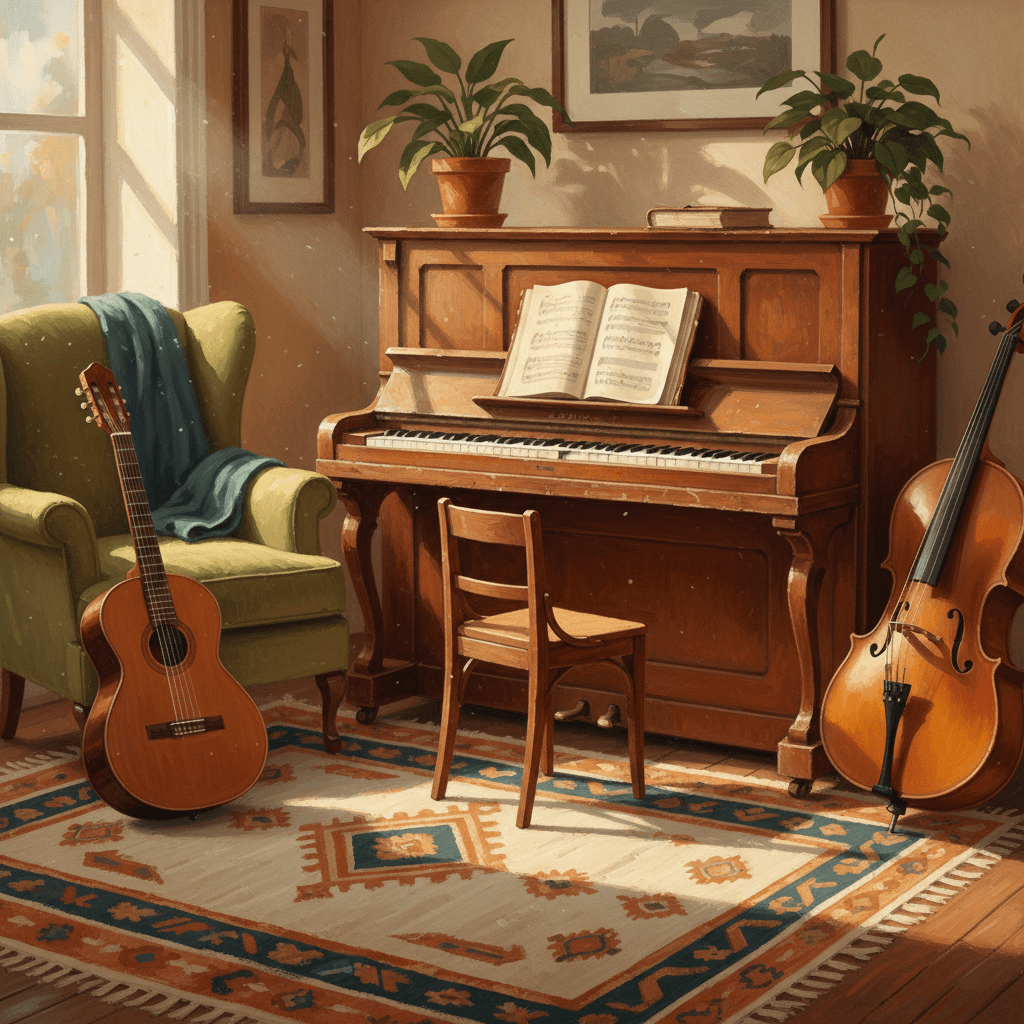
In-Person Piano Lessons Near You in Newfoundland: A Complete Guide
Find in-person piano lessons near you on the Avalon Peninsula. Learn what to expect for kids, teens, and adults, and how to choose the right local teacher.
In-person piano lessons give students something a screen simply cannot deliver: a trained teacher who reads your posture, guides your wrist angle, and catches small errors before they become habits. Whether you are a curious beginner in St. John's or a parent researching options for your child, local studio instruction remains the most effective starting point.
Why In-Person Piano Lessons Still Make a Real Difference
In an era when you can learn almost anything from a screen, the idea that in-person lessons offer something irreplaceable can feel old-fashioned. Yet every experienced piano teacher will tell you the same thing: a great deal of learning happens in the three feet between student and teacher, and no camera fully captures it. Physical presence allows for the kind of nuanced, moment-to-moment feedback that shapes technique, prevents injury, and builds real musical confidence from the very first session.
How a Teacher Reads Your Body, Not Just Your Playing
A professional piano teacher does far more than listen to the notes you play. Within the first 5 minutes of a session, a seasoned instructor can spot a wrist alignment problem, notice that your shoulders are creeping toward your ears with tension, or observe that you are holding your breath on difficult passages. These physical cues are nearly invisible on video. In person, a teacher can gently guide your wrist angle, adjust your posture with a word or a light touch, and catch the finger curvature habits that, left uncorrected, could lead to discomfort or repetitive-strain issues down the road. This attentive observation keeps learning safe and efficient, not critical.
The Accountability Loop That Online Lessons Can't Fully Replicate
There is something quietly powerful about walking into a physical studio and sitting down with a caring, prepared teacher who remembers exactly where you left off last week, without rewinding a video recording. That social contract shapes behaviour in ways that are hard to manufacture digitally. Learning piano carries its own motivational challenges, and students who attend in-person sessions consistently report stronger week-to-week practice habits. The student knows the teacher will notice whether they practised; the teacher knows the student's discouragement patterns by sight.
What Does "Near Me" Actually Mean for Avalon-Area Learners?
For many Newfoundland families, "near me" translates to a commute of roughly 10 to 45 minutes. Communities across the Avalon Peninsula, including St. John's, CBS (Conception Bay South), Mount Pearl, Bay Roberts, and Brigus, are all within a realistic driving radius of a local studio. Madison Curtis teaches across the Avalon at multiple locations, making it practical for families in these areas to access consistent, face-to-face instruction. You can explore piano and voice lessons near you in Newfoundland to get a clearer sense of what is available in your community. Be sure to contact the studio to confirm availability in your specific area and to discuss scheduling. To supplement your local search, you can also find a qualified local piano teacher through broader directories while you narrow down your options.
What to Expect From Private Piano Lessons as a Total Beginner
Picture this: you sit down at the piano for the very first time, hands hovering nervously over the keys, wondering if you have made a mistake signing up. Within 20 minutes, most beginners leave that first session having played their first simple melody and feeling a quiet kind of pride they did not expect. That first session sets the tone for everything that follows, and knowing what to anticipate makes it far less intimidating.
Your Very First Session: What Typically Happens?
A typical beginner first session runs 30 to 45 minutes and moves through clear, unhurried stages. The teacher begins with introductions and a brief conversation about your goals, perhaps 5 minutes. Then comes posture and bench height, another 5 minutes, because a comfortable, aligned body is the foundation of everything. From there, a 10-minute tour of keyboard geography and note names gives you a mental map of the instrument. You then spend about 10 minutes playing your first 5-finger melody. The session closes with a simple take-home assignment so the next week has a clear starting point. The lesson feels approachable, not overwhelming.
How Music Theory Is Woven Into Practical Playing From Day One
Good music teaching never drops a pile of theory worksheets in front of a nervous beginner. Instead, theory emerges naturally from what you are actually playing. Counting beats aloud as you play teaches rhythm without abstraction. Naming the notes on the staff becomes meaningful because those notes appear in your piece. Spotting a time signature in a song you already recognise makes the concept click immediately. Well-structured curricula aligned with RCM (Royal Conservatory of Music) frameworks integrate theory organically, so students build genuine understanding through learning rather than dry memorisation. Theory becomes something you do, not something you study separately.
Reading Sheet Music vs. Playing by Ear: Do You Have to Choose?
A strong piano education develops both skills, and you absolutely do not have to choose between them. Sheet-music reading builds musical literacy and opens access to a vast published repertoire spanning centuries. Ear training builds musicality, improvisation instinct, and the ability to learn a song you hear and love. Neither skill is innate; both are taught through patient, well-sequenced practice. Skilled teachers design these two strands to complement each other so that your literacy reinforces your ear, and your ear deepens your understanding of the instrument.
How Long Before You Can Play a Real Song?
Here is an honest, encouraging answer: most dedicated beginner students play a simple recognisable piece within 3 to 4 weeks of starting private piano lessons. A moderately complex piece, such as a pop song or a classical work at an early RCM grade level, typically comes within 3 to 6 months of consistent study and home practice. Progress depends significantly on how often you practise between sessions. Young beginners benefit from 10 to 15 minutes daily; adults tend to do well with 20 to 30 minutes, 4 to 5 days a week. Short, focused sessions are far more effective than occasional marathon sit-downs. For a fuller picture of the adult journey, see what adults can expect from their first few months of lessons. Honest progress takes time and patience, and it is genuinely worth it.
Piano Lessons for Kids: Age-by-Age Learning Milestones
When is a child actually ready for piano lessons for kids, and what does "ready" even mean? The answer depends far less on a magic birthday number than most parents assume, and far more on a handful of observable developmental markers your child may already be showing right now. Understanding these milestones helps you choose the right moment and set realistic, encouraging expectations for your young learner.
| Age Range | Typical Readiness Signs | Recommended Lesson Length | Focus Areas |
|---|---|---|---|
| Ages 3 to 4 | Enjoys music, can clap a simple beat, curious about keys | 20 to 30 minutes | Rhythm, listening games, keyboard exploration |
| Ages 5 to 6 | Can follow 2-step directions, sits focused for 10 min, shows finger independence | 30 minutes | Note names, 5-finger patterns, basic notation |
| Ages 7 to 10 | Reads simple text, can sustain attention for 30 min, goal-oriented | 30 to 45 minutes | Notation, scales, both-hands coordination, simple theory |
| Ages 11 to 14 | Abstract reasoning emerging, self-motivated, has musical preferences | 45 minutes | Student-chosen repertoire, improvisation, intermediate theory |
Is My Child Ready for Piano Lessons? Signs by Developmental Stage
Readiness is less about age and more about observable behaviour. Look for a child who can sit engaged with an activity for 10 to 15 minutes, who shows curiosity about the piano or music in general, who can follow a 2-step instruction without losing the thread, and who has beginning finger independence, meaning they can move one finger without forcing all the others to move at the same time. Not every child reaches these markers at the same point, and that is completely normal. A good teacher will conduct a gentle readiness check at the very first session, so there is no pressure on parents to make a precise call alone.
How Lessons Are Structured Differently for Toddlers, School-Age Children, and Tweens
Piano classes look quite different depending on the developmental stage. For toddlers and preschoolers aged 3 to 4, sessions are exploratory and game-based, structured around listening, movement, and free keyboard discovery rather than notation. School begins to shape readiness: children aged 5 to 7 can start recognising written notes, playing simple pieces, and absorbing rudimentary theory. Tweens benefit from greater autonomy, with students choosing some of their own repertoire and beginning to explore improvisation. You can read more about what to expect from piano lessons for three-year-olds if your youngest is already showing interest.
Keeping Young Learners Engaged: Games, Repertoire Choices, and Short Wins
Motivation in young learners is sustained through novelty, choice, and frequent visible progress. Games that make music theory stick include note-name flashcard races, rhythm-clapping challenges, and call-and-response ear games that build skills while feeling like play. Letting students choose one song per term from a genre they genuinely love, whether it is a film theme, a pop hit, or a folk song, sends a powerful message: this music is yours. Piano classes should also build in short, observable wins every 2 to 3 weeks. Completing a piece from start to finish, even a very simple one, gives young learners the concrete proof they need that their effort is actually working. The teacher's role is to offer those moments strategically.
How Parents Can Support Practice at Home Without Becoming the Villain
Supporting home practice is one of the most powerful things a parent can do for a young learner's progress, and it does not require musical expertise. Here are four practical strategies that work:
Set a consistent daily practice time, ideally the same time each day, so it becomes as automatic as brushing teeth. Sit nearby rather than hovering directly over the keyboard, which signals support without pressure. Celebrate effort rather than perfection: "I noticed you kept going even when that part was hard" is far more useful than "that sounded wrong." Avoid correcting technique yourself; leave that entirely to the piano teacher, whose job it is to address those details with the right pedagogical rationale. Keep sessions short and positive. Ten focused minutes at age 6 is genuinely productive. Some days will be a battle, and that is entirely normal. A calm, low-stakes environment at home makes the studio feel like a welcome refuge, not an extension of homework.
What Motor-Skill Development Has to Do With Piano Progress
Fine motor control is the physical foundation of piano technique, and it develops on its own biological schedule. The myelination of neural pathways involved in fine finger coordination, the process by which nerve signals travel faster and more precisely, continues throughout childhood. This is why a 5-year-old benefits most from simple 5-finger patterns before attempting scales: their nervous system is still consolidating the motor circuitry needed for more complex movement. A 9-year-old can move through the same foundational material noticeably faster, not because they are more talented, but because their instrument-specific motor pathways are more mature. A professional teacher accounts for this biology in lesson pacing, never rushing a young student past what their developing hands can comfortably manage.
Piano Lessons for Teens and Adults: It Is Never Too Late to Start
The myth that adult learners cannot become accomplished pianists was largely constructed around conservatory pipelines designed for children, institutions that needed students to begin at age 5 or 6 to reach professional performance level by their twenties. For the vast majority of people who want to play piano for joy, self-expression, and lifelong enrichment, that pipeline is simply irrelevant. The real question is not whether you started young enough; it is whether you have found the right teacher and the right approach for where you are right now.
Five reasons adult and teen learners thrive in private piano lessons:
- Stronger goal-setting: adults know why they want to play, and that clarity accelerates early progress
- Freedom to choose repertoire that genuinely excites them, from Chopin to Coldplay
- Life experience enriches musical interpretation in ways that younger students simply do not yet possess
- Schedule flexibility: lessons can be anchored around work, school, and family commitments
- No performance-exam pressure unless the learner actively wants that framework
Why Adult Learners Progress Differently, and Often Faster in Some Areas
Adult learners bring real cognitive advantages to the piano studio. Stronger working memory means verbal instruction lands quickly and stays. Prior musical exposure, even passive listening to decades of music, gives adults an intuitive sense of phrasing and dynamics before they have played a single scale. Adults can self-correct with a single well-worded suggestion from the teacher. Hand flexibility and new motor-skill formation do take longer to develop than in childhood, and honest acknowledgment of that fact is part of a good teacher-student relationship. On balance, though, the adult learner who commits to regular lessons can learn a great deal in a short time. Explore music lessons for adults across Newfoundland to see what a professional local curriculum can look like.
What Styles Can You Focus On? Classical, Jazz, Contemporary, and Improvisation
One of the joys of adult music study is that you get to choose your direction. Classical piano builds technique, notation fluency, and an understanding of musical structure that underpins everything else. Jazz introduces chord voicings, rhythmic complexity, and improvisation from relatively early on, making it exciting for adults who want creative freedom. Contemporary and pop repertoire delivers early wins: familiar songs feel rewarding to play within weeks. Improvisation as a focus builds creative confidence and makes the instrument feel personal. A thoughtful teacher will offer a blend of styles tailored to your goals, drawing from whichever tradition best serves where you want to go.
How Do You Balance Lessons With a Busy Schedule?
Consistency matters more than volume. A weekly 30 or 45 minute lesson anchored to the same day and time is far more sustainable than sporadic longer sessions. For home practice, 15 to 20 minutes of focused daily work, rather than an hour-long weekend session, produces steadier improvement and keeps the material fresh in your memory. A simple practice journal, noting what you worked on and what felt unclear, gives both you and your teacher a clear roadmap for the following week. Madison Curtis offers flexible scheduling designed for working adults and teens with busy school commitments, so the student who has limited time is not left without options. Reach out to contact the studio about available time slots that fit your week.
How to Choose the Right Piano Teacher Near You
A survey of music parents found that more than 60% of students who quit lessons in the first year cited "not connecting with the teacher" as a primary reason, not difficulty, not cost, not lack of interest in music itself. Choosing the right teacher may be the single most important variable in whether lessons last and whether they produce genuine, lasting growth in the learner.
What Qualifications and Teaching Experience Should You Look For?
Credentials worth noting include RCM (Royal Conservatory of Music) certification, university music education degrees, and the ARCT (Associate of the Royal Conservatory) designation, all recognised signals of structured pedagogical training in Canada. A certified academy background indicates that a teacher has studied not just how to play, but how to teach. It is worth remembering that performance excellence alone does not equal teaching skill; the two are genuinely different disciplines. Ask any prospective professional teacher how many years they have worked specifically with students in your child's age group, and whether their school of teaching draws on a recognised method framework. Experience with your specific learner profile matters.
Why Lesson Philosophy Matters as Much as Credentials
A teacher's philosophy shapes everything about the learning experience: whether technique and theory are integrated or taught in isolation, whether the student's own goals drive repertoire selection, how mistakes are treated in the moment, and how progress is measured over time. Consider two contrasting approaches. In a rote-drill model, students repeat exercises until accuracy arrives, with little explanation of why. In a curiosity-led model, every exercise connects to a musical outcome the student cares about, and learning is framed as exploration rather than correction. Neither is inherently wrong, but parents and learners deserve to understand which philosophy they are signing up for. Ask directly, and listen carefully to the answer. Music education philosophy is not abstract; it shows up in every single lesson.
How Can You Tell if a Teacher Is a Good Fit After the First Lesson?
One lesson gives you more information than you might think. Watch for three signals. First, the student (or adult learner) is already talking spontaneously about something they learned, unprompted. Second, the teacher sent home a specific practice task with a clear reason attached, not just "practise pages 4 and 5." Third, the student felt heard rather than evaluated, as though the teacher was genuinely interested in their goals and their pace. These three signs, if all present, suggest a teaching relationship worth continuing. One lesson is a data point, not a verdict, but a strong first data point is a meaningful predictor for a beginner who needs encouragement most.
Questions to Ask Before You Book
Asking the right questions before committing saves both time and disappointment. Here is a practical list to bring to your first conversation with any prospective teacher:
- What curriculum or method do you use, and how do you adapt it for different learners?
- Do you follow or reference the RCM syllabus, or do you use a different framework?
- How do you approach piano classes for a student who is bored versus one who is struggling?
- What is your privacy policy regarding student records, session notes, and any video recordings taken for practice reference?
- Do you offer a trial lesson, and what does that trial session typically look like?
- How do you communicate with parents about progress between sessions?
- What is your policy on missed lessons and rescheduling?
- How do you incorporate student choice into repertoire selection?
You can also browse profiles of professional piano tutors on broader platforms to get a sense of the range of credentials and teaching philosophies out there before you make your local choice. Similarly, find and compare local piano teachers in your area to understand what local options look like before committing to a term.
Key Takeaways
- In-person instruction allows a teacher to catch posture, wrist, and finger issues in real time, protecting young learners from reinforcing bad habits over weeks of solo practice.
- Most dedicated beginners can play a recognisable simple piece within 3 to 4 weeks; an intermediate piece is typically achievable within 3 to 6 months of consistent lessons and daily practice.
- Readiness for private piano lessons depends on developmental markers, not a fixed birthday; observable signs like sustained focus and finger independence matter more than age alone.
- Adult and teen learners progress strongly in private piano lessons because stronger abstract reasoning and clear personal goals compensate for the motor-skill advantages younger children hold.
- Choosing a teacher whose philosophy aligns with your learner's needs is at least as important as checking credentials; ask about philosophy, curriculum, and missed-lesson policy before booking.
FAQ
What age should a child start piano lessons?
Most music educators consider ages 5 to 6 a common and productive starting point for structured piano instruction, because fine motor skills and the ability to follow sequential directions are typically in place by then. Children aged 3 to 4 can benefit from exploratory, game-based pre-piano activities focused on rhythm and listening. Signs of readiness matter more than a specific birthday. A brief first session with a qualified teacher can clarify readiness quickly.
How many minutes a day should a beginner practise piano?
Consistent short sessions work better than infrequent long ones. Young beginners aged 5 to 7 benefit from 10 to 15 minutes of focused daily practice. Older children and teens typically do well with 20 to 30 minutes. Adults are most productive with 20 to 30 minutes, 4 to 5 days per week. Daily repetition keeps new motor patterns and note-reading skills fresh between weekly lessons, which is the key driver of steady progress.
Do I need a full acoustic piano or will a keyboard work for lessons?
A quality weighted-key keyboard with at least 61 keys is a practical starting point for beginners, particularly for younger learners or families with limited space. Weighted keys simulate the resistance of an acoustic guitar or grand piano action, which matters for developing proper finger strength and touch sensitivity. Teachers often recommend upgrading to a full 88-key weighted instrument within the first year of study as technique develops. Discuss this with your teacher before purchasing.
What is the difference between a certified and an uncertified piano teacher?
A certified academy teacher has completed formal pedagogy training through a recognised body such as the Royal Conservatory of Music, not just a performance degree or years of playing experience. Certification signals that the teacher understands child development, learning sequencing, and technique instruction from an educational standpoint. Uncertified teachers may still be excellent, particularly with significant private teaching experience, but certification provides an independent benchmark for pedagogical competence that parents can verify.
Can I take piano lessons online instead of in person?
Online lessons are a convenient option when in-person access is limited, but they carry real trade-offs. A teacher cannot physically guide posture, wrist angle, or hand position through a screen. Audio quality and latency make subtle rhythmic and dynamic feedback harder to deliver. For absolute beginners, especially young children, in-person lessons during the foundational months are strongly recommended. Once basic technique is established, a hybrid model combining online sessions with periodic in-person check-ins can work well for some learners.
What does "united states email teacher" mean when I see it on lesson directories?
When browsing platforms that list piano instructors across both Canada and the United States, email teacher buttons and location filters sometimes default to a broad North American search. Always filter specifically by province or postal code to find genuinely local Newfoundland teachers. The phrase united states email teacher is essentially directory navigation language; it appears on school select dropdowns and search result pages when a platform serves both markets. Use location filters carefully to find someone who can meet you in person across the Avalon.
What styles of music can a beginner learn on piano?
Beginners can start with classical pieces, contemporary pop songs, folk melodies, and simple blues progressions from the very first term. Most teachers introduce classical technique because it builds strong finger independence and reading skills, while also weaving in electric bass line concepts in left-hand patterns and pop chord progressions as motivational tools. The best teachers blend styles to suit the learner's goals, so do not hesitate to tell your teacher what music you love from the first session onward. For more on lesson formats and styles, visit the Madison Curtis home page or browse the blog for topic-specific guidance.