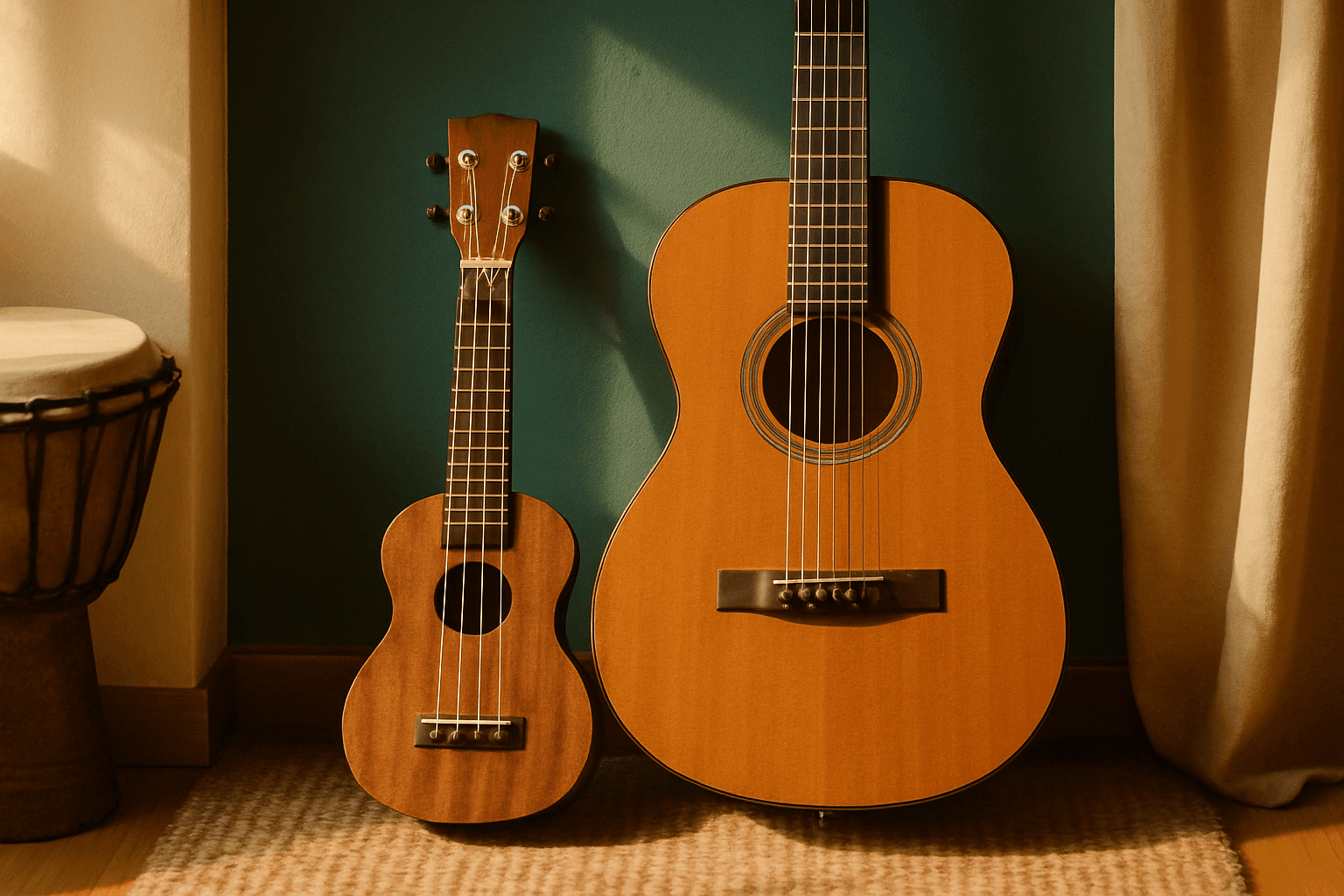
Ukulele vs Guitar for Beginners: How to Choose the Right Instrument
Compare ukulele and guitar for beginners by cost, learning curve, and fit. Find which instrument suits your child or your own hands, and helps you stick with it.
Choosing between a ukulele and a guitar comes down to hand size, learning goals, and how quickly you want to play a real song. For most younger children and complete beginners, the ukulele's four nylon strings and compact body offer a gentler on-ramp, while the guitar's wider range rewards the extra early effort.
What Makes These Two Instruments So Different?
Choosing between a ukulele and a guitar is a bit like deciding between a cozy bicycle and a ten-speed road bike. Both get you somewhere wonderful, but the ride feels completely different from the first moment you pick them up. Understanding those differences before you buy saves frustration and keeps early enthusiasm alive. Before comparing difficulty, cost, or repertoire, it helps to get grounded in what each instrument physically is, how it sits in your hands, how many strings you manage, and what it sounds like in a room.
| Instrument | Strings | Typical Tuning | Body Length | String Material | Approx. Beginner Price (CAD) |
|---|---|---|---|---|---|
| Soprano Ukulele | 4 | G-C-E-A | ~21 inches | Nylon / fluorocarbon | $60–$150 |
| Concert Ukulele | 4 | G-C-E-A | ~23 inches | Nylon / fluorocarbon | $80–$200 |
| Acoustic Guitar | 6 | E-A-D-G-B-E | ~38–40 inches | Steel | $120–$250 |
| Classical Guitar | 6 | E-A-D-G-B-E | ~38–40 inches | Nylon | $130–$270 |
Size, shape, and how each instrument feels in your hands
A soprano ukulele body measures roughly 21 inches from end to end, which means it fits comfortably across a child's lap without any awkward slouching. Concert and tenor ukuleles offer slightly more body for players who want a rounder tone while keeping the instrument manageable. A full dreadnought guitar, by contrast, runs 38 to 40 inches in length and carries real physical weight. For adults, that size feels natural after a few weeks; for younger learners, holding a full guitar for a 30-minute lesson can produce arm fatigue before a single chord sounds clean. The smaller body is not just about cuteness, it directly reduces the physical effort of the first lesson.
String count and tuning: why four strings changes everything
Standard ukulele tuning is G-C-E-A, and the ukulele's construction and tuning has been shaped by its Hawaiian origins into a compact, accessible system. One detail worth knowing as a beginner: the G string on a soprano ukulele is often a reentrant high G rather than a low G, meaning the strings do not descend in pitch the way guitar strings do. This gives the ukulele its bright, distinctive ring but can catch newcomers off guard. Four strings instead of six means fewer finger placements per chord, fewer notes to think about simultaneously, and a faster path to that first satisfying strum. For more beginner instrument guides on this site, browse the blog. Standard guitar tuning, E-A-D-G-B-E, adds two more strings and significantly more harmonic territory to navigate from day one.
How does the sound of a ukulele compare to a guitar?
The ukulele produces a bright, warm, mid-range tone that many listeners describe as cheerful and immediately recognisable. It gained global popularity in the early 20th century through Hawaiian music and has since found its way into indie pop, folk, and children's repertoire worldwide. A guitar covers a much wide range, from genuine bass notes to bright treble, and can produce fuller, harmonically richer chords. Neither instrument is objectively superior, they simply serve different musical moods, and the best choice is the one that makes you want to pick it up tomorrow.
Nylon, steel, and fingertip comfort explained
Ukulele strings are made from nylon strings or fluorocarbon, which are soft against the fingertips and require relatively little pressure to fret cleanly. Most entry-level acoustic guitars use steel strings, which are under considerably higher tension and press into soft, unconditioned fingertips with surprising force. Fingertip calluses typically take two to four weeks to develop with daily practice on steel strings, and the soreness during that period is a genuine dropout factor, not something to brush aside. Classical guitars use nylon strings and sit between the two in terms of comfort. Parents often underestimate this pain point when selecting a child's first instrument. Reviewing Sweetwater's side-by-side comparison of chord playability reveals just how much string tension influences early practice habits and overall commitment.
--- See also: explore guitar fundamentals and beginner techniques.
Learning Curve Compared: Is Ukulele Really Easier to Learn Than Guitar?
The ukulele does not just seem easier than the guitar, for most complete beginners, it genuinely is, at least in the first 8–12 weeks. But "easier to start" and "easier to master" are two very different things, and understanding that distinction will shape which instrument actually fits your goals. Both instruments reward consistent practice, but their on-ramps are built very differently, and choosing the right on-ramp makes a significant difference to whether a learner sticks with music or quietly gives up after two months.
Why fewer strings and simpler chord shapes help total beginners
Cognitive load matters enormously in early learning. When a beginner has fewer decisions to make per chord, the brain can devote more attention to rhythm, strumming, and listening, the parts of music that actually feel satisfying. A C chord on the ukulele requires just one finger on one string; the same chord on a guitar uses three fingers spread across five strings. Fewer chord fingering combinations on a four-string instrument means a faster positive feedback loop, which keeps motivation high in those critical early weeks when habits are forming. That said, ukulele easier does not mean automatically easy for every learner, hand coordination still takes practice.
How motor-skill development in children affects which instrument clicks faster
Fine motor skills in children between the ages of 6 and 10 are developing rapidly, but they are not yet fully formed. The ukulele's shorter scale length and narrower neck align more naturally with the developing hand anatomy of a young learner. A typical guitar nut measures 43 to 45 millimetres wide, while a soprano ukulele nut is closer to 35 millimetres, a meaningful difference when small fingers are trying to hold down strings without touching adjacent ones. The music education philosophy at Madison Curtis Music, rooted in meeting each student where they are physically and developmentally, reflects exactly this kind of thinking. Even adults with smaller hands report that the ukulele's narrower neck reduces strain during the first month of learning.
Is the ukulele easier to learn, or does it just feel that way at first?
There is a real "honeymoon" effect with the ukulele. Early wins, strumming a two-chord song, impressing a sibling, playing along to a favourite tune, feel enormous and arrive quickly. But the ukulele has its own advanced techniques: fingerpicking, chord melody arrangements, jazz voicings, and percussive strumming all take genuine time and dedication to develop. The instrument is not trivially simple at an intermediate or advanced level. What is genuinely different is the on-ramp: the ukulele's gentler learning curve means beginners reach their first musical milestone faster, which builds the identity and motivation needed to continue through the harder stages ahead.
Where guitar gets harder, and why that difficulty pays off later
The notorious beginner wall on learning guitar is the barre chord, particularly the F chord, which typically takes weeks to months of daily practice before it rings cleanly. Six strings also mean more music theory to absorb simultaneously: intervals, bass notes, and voicings all become relevant earlier. However, guitar's construction and musical range are precisely what make it such a versatile long-term investment. A confident guitarist can accompany virtually any genre, pop, classical, rock, folk, blues, and country, and can cover bass, harmony, and melody within a single instrument. The difficulty investment on guitar yields a broader musical toolkit that pays dividends for decades. It is not a discouraging fact; it is context for realistic expectations.
Which instrument lets you play a real song in your first week?
Most beginners can strum a recognisable ukulele song within one to two weeks. Guitar open chords typically require three to six weeks to sound clean for most adults. Here are five achievable songs on each instrument within your very first week of practice:
Ukulele, Week 1 songs (2–3 chords each):
- "Somewhere Over the Rainbow", 2 chords, slow tempo, iconic melody
- "You Are My Sunshine", 3 chords, familiar to all ages
- "Riptide" by Vance Joy, 3 chords, hugely motivating for teens and adults
- "Happy Birthday", single-chord melody, great for absolute day-one beginners
- "I'm Yours" by Jason Mraz, 4 chords, relaxed strumming pattern
Guitar, Week 1 songs (2 open chords, manageable finger strength):
- "Knockin' on Heaven's Door", Em and G, two chords, steady rhythm
- "A Horse With No Name", Em and D6, two finger shapes held throughout
- "Brown Eyed Girl" (intro picking), rewards patience with recognisable reward
- "Wish You Were Here" by Pink Floyd, fingerpicking pattern, two main chords
- "House of the Rising Sun", arpeggiated chords, atmospheric and satisfying
The ukulele songs listed here lean heavily on two to three chords. Playing a recognisable song within the first week is a powerful confidence builder, and the ukulele makes that milestone more accessible for most beginners.
--- See also: Finding the right lesson schedule for your child.
Ukulele vs Guitar for Kids: Which Is the Better First Instrument?
Picture a seven-year-old settling onto the piano bench, except instead of a piano, someone has handed her a full-size dreadnought guitar nearly as tall as she is. The instrument wins. She puts it down. That scenario plays out in music stores across Canada every year, and it is entirely avoidable with the right starting choice. Selecting an instrument that physically fits a child is not just a comfort issue; it is a developmental one that shapes whether music becomes a lifelong passion or a short-lived experiment.
Hand size, finger strength, and the physical case for starting young learners on ukulele
A soprano ukulele's scale length is approximately 13 inches, compared to the standard guitar scale of 25.5 inches. That difference translates directly into the distance between frets, smaller fret spacing means children can form chord shapes without straining tendons or overextending small fingers. The nut width comparison tells a similar story: roughly 35 millimetres on a ukulele versus 43 to 45 millimetres on a guitar. The buying guidance for a child's first instrument from NAMM consistently emphasises matching instrument size to the player's body as a top priority. A soprano ukulele is suitable for children as young as four or five years old, while a full-size guitar is typically recommended for ages ten and up. Physical comfort at the beginning is not a luxury, it is the foundation.
Is guitar too big for younger children to hold comfortably?
Full-size guitars are not recommended for children under age ten by most music educators, and for good reason. The body depth and overall weight create poor posture habits that can cause real long-term discomfort if left uncorrected. Half-size and three-quarter guitars, measuring approximately 34 to 36 inches, exist as genuine options for children around age seven, and a 3/4-size guitar can be a reasonable bridge instrument. The practical advice for parents is simple: bring your child to a music shop and let them hold both a ukulele and the appropriately sized guitar before purchasing. A poor physical fit is consistently cited as one of the top reasons children abandon lessons within the first six months.
How early wins on an easier instrument build lasting musical confidence
When a child plays a recognisable melody in their very first week, something important happens: they begin to think of themselves as a musician. That identity shift is not trivial. Research in music education points to self-efficacy, the belief that one can succeed, as a stronger predictor of long-term practice than raw talent. Musical confidence built early on a manageable instrument transfers directly: children who master simpler material are more willing to tackle harder challenges later, including the eventual leap to guitar. Students who continue music lessons past the three-month mark are significantly more likely to maintain the habit long-term. Find more perspectives on building music confidence in children at the blog.
Chord Shapes, Repertoire, and Musical Possibilities
How many chords do you actually need to play the songs you love? You might be surprised. For most popular music, from classic pop to folk to contemporary hits, the answer is somewhere between 3 and 6, and both the ukulele and guitar can get you there, just via slightly different roads. The chord landscape on each instrument is more accessible than most beginners imagine, and understanding it ahead of time removes one of the most common sources of pre-purchase anxiety.
How many chords do you need to play most beginner songs on each instrument?
The I–V–vi–IV chord progression underpins hundreds of popular songs, and both instruments can deliver it. Here is how the finger work compares on the four most common beginner chords:
| Chord | Ukulele Fingers Needed | Guitar Fingers Needed | Difficulty, Ukulele (1–5) | Difficulty, Guitar (1–5) |
|---|---|---|---|---|
| C | 1 | 3 | 1 | 2 |
| G | 2–3 | 3 | 2 | 3 |
| Am | 2 | 2 | 2 | 2 |
| F | 2 | 3–4 (barre) | 2 | 4 |
Four chords unlock a remarkably wide pop repertoire on both instruments. The ukulele consistently demands fewer fingers per chord shape, which means beginners reach a playable level faster, but the guitar's chord voicings carry more harmonic weight once mastered.
Does the guitar have more chords and musical range than the ukulele?
A guitar's six strings of a guitar allow bass notes to sit naturally within chord voicings, creating a fuller, harmonically richer sound that a ukulele simply cannot replicate at the low end of the frequency range. Guitar can play in registers completely inaccessible to the ukulele. That said, the ukulele's four strings still support genuinely complex music: jazz chord voicings, fingerstyle arrangements, and even classical transcriptions are all possible and practised widely. Sweetwater's side-by-side comparison of chord playability makes clear that the guitar's wider musical range is real but does not render the ukulele a limited instrument. Both share the same Western chord theory foundation, learning one genuinely informs the other.
Song libraries: what genres feel most natural on each instrument
Musical genres fit is an underrated factor in instrument choice. Here is where each instrument tends to shine:
- Ukulele: Hawaiian traditional, indie pop, folk, singer-songwriter, children's music, acoustic covers of pop hits
- Guitar: Rock, blues, country, classical, flamenco, folk, pop, film music, metal
- Overlapping territory: Folk, pop, and acoustic singer-songwriter material feel natural on both instruments
The overlap in pop and folk music is significant, a beginner learning either instrument will find plenty of motivating repertoire. Genre should be a genuine factor in your decision. If a child is obsessed with country music or classic rock, the guitar will feel more emotionally connected to their musical world, and that emotional pull matters more than any technical consideration.
Does learning ukulele first make it easier to transition to guitar later?
The transition from ukulele to guitar is meaningfully smoother than starting guitar cold. Chord shapes for C, Am, F, and G translate directly between instruments, requiring only fingering adjustments for the two extra guitar strings. Strumming patterns, rhythmic concepts, and the skill of reading chord diagrams are all transferable without relearning. The mental leap to guitar from an intermediate ukulele level is real but manageable, students typically need three to six months of focused practice to reach equivalent guitar comfort. The main adjustments are adapting to higher string tension on steel-string guitars and learning barre chords from scratch. Frame the ukulele as a genuine stepping stone, not a shortcut, the skills built there are real and durable.
Cost and Starter Gear: What Should a Canadian Beginner Budget For?
According to industry data, first-time instrument buyers in Canada spend an average of CAD $150–$300 on a starter setup, but the range varies enormously depending on which instrument they choose and whether they factor in music lessons, accessories, and ongoing upkeep. Getting the budget picture right before you buy prevents an expensive surprise in month two. Neither instrument has to break the bank, but the full cost of entry is higher than the sticker price on the instrument itself.
What does a decent beginner ukulele cost in Canada?
A quality beginner soprano ukulele in Canada runs between CAD $60 and $150. In that range, brands like Kala and Makala offer solid laminate construction, reliable tuning pegs, and strings good enough to learn on without immediately replacing them. Spending below $60 risks an instrument that will not stay in tune, which is genuinely discouraging for a new learner. A soprano ukulele at the $80–$120 price point hits the sweet spot for most Canadian families, good enough to learn on seriously, affordable enough that the investment is not daunting if the learner decides music is not for them after all. Ukulele strings are inexpensive to replace, typically costing CAD $8 to $15 per set and lasting well with regular care.
Which instrument is more affordable for beginners overall?
Entry-level acoustic guitars cost CAD $120 to $250 at reputable retailers, slightly more than a starter ukulele, but not dramatically so. The real cost difference shows up in accessories: guitar beginner accessories typically include a strap ($15), picks ($5–$10), a clip-on tuner ($20), and often a capo ($15), adding $55 or more to the initial outlay. Ukulele beginners generally need only a tuner and perhaps a padded gig bag. Guitar strings also need replacement every three to six months with regular playing. Consulting the instrument-buying checklist for first-time buyers from NAMM before you shop helps avoid overlooking these hidden costs. Online lessons can also be an affordable option for families seeking flexible scheduling, though in-person instruction from a qualified teacher is typically recommended for beginners of either instrument to establish proper technique from the start.
Key Takeaways
- Start with fit, not prestige. A ukulele that fits a child's hands will produce more musicians than a full guitar that does not. Physical comfort in the first month determines whether practice continues.
- The ukulele's shorter on-ramp is real. Most beginners play a recognisable song within one to two weeks on ukulele versus three to six weeks on guitar, and those early wins build the identity and habit that make music stick.
- Guitar rewards patience with range. If broader musical genres versatility, bass notes, and long-term harmonic depth matter to you or your child, the extra difficulty of guitar is a worthwhile investment, not a deterrent.
- Ukulele skills transfer. Chord shapes, strumming patterns, and chord-diagram reading all carry over when a player eventually moves to guitar, making the ukulele a genuine stepping stone rather than a detour.
- Budget for the full setup. Factor in accessories, strings, and lessons from the start, the instrument price is only part of the picture, and both options are accessible to most Canadian families with realistic planning.
FAQ
Is ukulele easier than guitar for a complete beginner?
For most complete beginners, yes, especially in the first eight to twelve weeks. Here is why:
- A ukulele has 4 strings versus guitar's 6, reducing chord complexity immediately
- The C chord on ukulele requires 1 finger; on guitar it requires 3
- Nylon strings are softer on fingertips than steel guitar strings
- The smaller body and shorter scale length reduce physical fatigue in early lessons
The ukulele's on-ramp is gentler, though both instruments require sustained practice to reach an intermediate level.
What age is best to start ukulele lessons?
Most music educators consider ages 4 to 5 a reasonable starting point for soprano ukulele, provided lessons are kept short (15 to 20 minutes) and playful in format. The instrument's small body and soft strings suit developing hand anatomy well. Children as young as 6 can progress meaningfully with a qualified teacher. Guitar is typically introduced from around age 7 on a 3/4-size instrument, and full-size guitar from age 10 or older.
Can a child start on ukulele and switch to guitar later?
Yes, and the transition is smoother than starting guitar cold. Chord shapes for C, Am, F, and G carry over directly with minor fingering adjustments. Strumming rhythm, chord-diagram reading, and basic music theory all transfer. The main new challenges are adapting to higher string tension and learning barre chords. Students with a solid ukulele foundation typically reach beginner guitar comfort within three to six months of focused practice.
How much should I spend on a first ukulele in Canada?
A reliable beginner soprano ukulele in Canada costs between CAD $60 and $150. The $80–$120 range generally offers the best balance of build quality and affordability. Spending under $60 risks poor intonation and tuning instability, which actively hinders learning. Add a clip-on tuner ($20) and a padded bag ($20–$30) to your budget. String replacements cost approximately $8–$15 per set and are only needed every several months with regular practice.
Is ukulele a "real" instrument or just a beginner toy?
The ukulele is unquestionably a real instrument with a rich history rooted in Hawaiian music and a global contemporary presence. It supports complex techniques including fingerpicking, chord melody, percussive strumming, and jazz voicings. Professional musicians, including Jake Shimabukuro and James Hill, have demonstrated the instrument's full artistic range. Calling it a beginner toy underestimates both the instrument and the players who have devoted serious study to it. It is a legitimate, expressive musical voice at every level of playing.
Does it matter which instrument a child wants to play an instrument?
Enormously. A child who is excited about a specific instrument, because they love a particular artist or musical genres, will practise more willingly and persist through early difficulties more readily than one assigned an instrument for purely practical reasons. Where possible, let enthusiasm drive the choice. If a child is genuinely drawn to both, a brief trial lesson on each instrument with a qualified teacher is the most reliable way to discover which one sparks the greater connection.