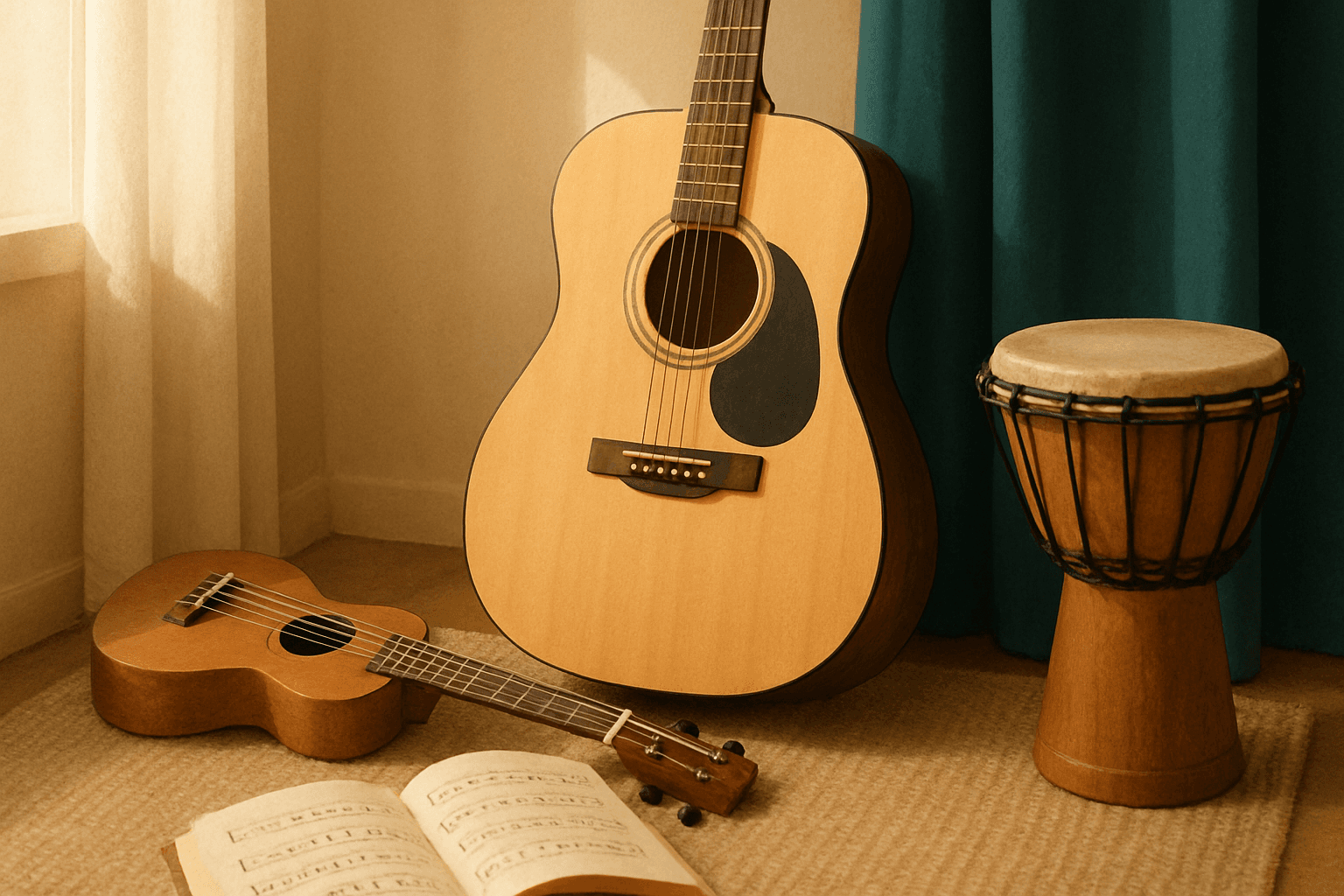
Guitar Lessons for Newbies: Your Complete Beginner Guide to Chords, Techniques, and First Songs
Start guitar with confidence. Learn the 5 essential chords, core techniques, and easy songs that help beginners make real music from day one.
Most beginners can strum a recognisable chord in their very first session. Guitar lessons for newbies work because open chords need just two or three fingers, motor skills build quickly with daily practice, and a handful of chord shapes unlock hundreds of real songs. This guide walks you through everything you need to get started.
Why Starting Guitar Is Easier Than You Think (Even as a Total Newbie)
Many people put off picking up the guitar for years because they assume it demands natural talent or years of formal training before anything sounds good. The truth? Most beginners can strum a recognisable chord within their very first session. The barrier to entry is genuinely lower than popular belief suggests, and understanding a little bit about how the instrument works makes that even clearer.
Learning the guitar means working with an instrument specifically designed for human hands. The 6-string layout in standard tuning (E A D G B e) places common chord shapes within a span most adults and older children can comfortably reach. Most beginner open chords require only 2 to 3 fingers, so your earliest days on guitar are about building simple shapes, not performing athletic feats. Motor-skill research suggests new physical patterns can start to feel natural within 21 days of consistent, short repetitions. And if you need inspiration before your first session, a structured introduction for first-time learners can give you a clear sense of the path ahead. YouTube hosts hundreds of millions of guitar tutorial views annually, which is powerful proof that the instrument is accessible to almost anyone with the motivation to try.
How does the guitar actually make sound, and why does that matter for learning?
When you pluck a string, it vibrates and those vibrations travel into the guitar body, which amplifies them through resonance. Think of it like shortening a rubber band: the shorter the vibrating portion, the higher the pitch. Pressing a fret shortens the string's vibrating length, raising the note. This mirrors what happens in the voice: just as vocal cords change tension to shift pitch, a guitarist changes string length by pressing different frets. Understanding this helps you troubleshoot the top beginner complaint, buzzing strings, because you quickly realise that pressing too lightly or too far from the fret wire disrupts clean vibration.
What a beginner guitar student can realistically achieve in the first 30 days
Framing progress in concrete milestones keeps practice purposeful. Many beginners find they can achieve the following:
- Days 1 to 3: Tune a guitar using a clip-on tuner or free smartphone app, and learn the names of the 6 strings.
- Days 5 to 10: Form two open chords cleanly, such as Em and Am, with fingers pressing close to the fret wire.
- Days 7 to 14: Strum a basic down-strum pattern in time with a metronome or backing track.
- Days 14 to 30: Play a 2-chord song recognisably from start to finish without stopping to look up chord shapes.
These are realistic targets for consistent practice of 15 to 20 minutes daily, not hours of marathon sessions.
Acoustic vs. electric guitar, which is the friendlier starting point?
Acoustic guitars have higher string action, meaning the strings sit further from the fretboard, which can make fingertips sore more quickly. They do, however, require zero extra gear. Electric guitars typically come strung with lighter strings (often 0.009 to 0.042 gauge) and lower action, which reduces finger fatigue noticeably in the early weeks. Classical guitars, strung with nylon rather than steel, are the gentlest option of all and are worth considering for younger learners or adults with sensitive fingertips. Ultimately, the best starting guitar is whichever one you are genuinely excited to pick up each day. If you are still weighing your options at an even earlier stage, our guide on ukulele or guitar as your first instrument walks through the comparison honestly. For more on this, see related industry context.
Setting Yourself Up for Success Before Your First Lesson
Think of setting up for guitar the way a chef preps a mise en place before cooking: having the right tools in order before you begin means your attention goes fully to learning, not scrambling for equipment. Twenty minutes of smart preparation before lesson one can save weeks of frustration and keep your early motivation intact.
Decent beginner acoustic guitars are available across Canada for $100 to $250 CAD, a range that gets you a playable, properly set-up instrument from a reputable brand. A clip-on chromatic tuner costs under $15 CAD and is arguably the single best investment a new guitarist can make. Children under age 10 typically do better with a 3/4-size (36-inch) guitar, while a capo (around $10 to $20 CAD) unlocks dozens of beginner-friendly songs the moment you are ready for them. For in-person and online guitar options near you, Long & McQuade is a well-established Canadian resource for both gear and lessons.
Choosing the right beginner guitar for your budget and hand size
Full-size guitars suit most adults and teenagers comfortably. Children aged 7 to 10 generally do better with a 3/4-size body, while ages 5 to 6 benefit from a 1/2-size instrument. Brands like Yamaha, Fender, and Seagull all offer reliable entry-level guitar options that hold tuning and stay playable without professional setup adjustments. Buying in-store lets you feel the neck profile before committing, which matters more than most beginners expect. Spending at least $100 CAD is worth it; instruments below that threshold often have factory defects that make clean fretting nearly impossible and quietly kill motivation in the first two weeks.
Essential gear every newbie needs from day one (and what to skip)
Start simple and build from there. Here is what actually matters on day one:
- Must-haves: A clip-on chromatic tuner, a few picks in the 0.60 to 0.73 mm thickness range, a guitar strap to keep posture stable, and one spare set of strings (they will break at an inconvenient moment).
- Nice-to-have later: A capo once you know a few chord shapes, and a simple guitar stand so the instrument stays visible.
- Skip for now: Expensive pedals, amp modellers, and multi-effects units. The use of a free tuning app like GuitarTuna or Fender Tune is a perfectly solid alternative to a clip-on tuner and costs nothing.
Fancy gear does not replace practice time, ever.
How to tune your guitar and why staying in tune builds better ears
Standard tuning runs E A D G B e from the thickest string to the thinnest. You can tune using a clip-on chromatic tuner, which reads vibrations through the headstock and shows you exactly how sharp or flat each string sits. Alternatively, try different smartphone apps until you find one that feels intuitive; GuitarTuna and Fender Tune are both reliable and free.
There is a neurological reward to tuning carefully: playing in tune trains the brain's relative pitch recognition over time, which is the same process behind solfège work in early vocal training. Think of yourself as the architect of your own musical ear, shaping it deliberately with every session. Even 5 minutes of attentive tuning per practice block builds that internal sense of pitch over months in a way that playing on an out-of-tune guitar simply cannot. For learners who want to deepen that ear-training foundation, the guide on music theory for beginners pairs well with this habit.
Building a simple, consistent practice space and schedule at home
Choose a dedicated chair without armrests so you can hold the guitar with proper posture. Good lighting prevents eye strain when reading a chord chart. Keep your guitar on a stand, not locked away in its case, because a visible instrument invites you to pick it up.
Each session becomes a space for new discoveries when your environment signals that it is time to play. Fifteen to 20 minutes of daily practice reliably outperforms a two-hour weekend session for motor-skill retention in beginners, because repetition across multiple days is how the brain consolidates physical patterns. Canadian households often find after-school slots or weekend mornings the most consistent windows. The habit-building principles explored in our piano practice schedule for kids translate directly to guitar: short, regular, and joyful beats long and infrequent every time.
| Item | Approx. Cost (CAD) | Priority |
|---|---|---|
| Beginner acoustic guitar | $100 to $250 | Must-Have |
| Clip-on chromatic tuner | Under $15 | Must-Have |
| Picks (assorted pack) | $3 to $8 | Must-Have |
| Guitar strap | $10 to $20 | Must-Have |
| Spare string set | $8 to $15 | Must-Have |
| Guitar stand | $15 to $30 | Nice-to-Have |
| Capo | $10 to $20 | Nice-to-Have |
| Beginner method book | $15 to $25 | Nice-to-Have |
The Essential Beginner Guitar Chords to Learn First
What if you could play guitar with hundreds of popular songs after mastering just five chord shapes? That is not a stretch: an enormous proportion of Western pop, folk, and rock music is built on the same small cluster of open chords. Learning these five shapes is the single highest-return investment a new guitarist can make, and you can find structured chord lessons at JustinGuitar to reinforce every shape described here.
Em, Am, C, G, and D cover an estimated 60 to 70 percent of beginner-friendly songs in popular music. Em requires only 2 fingers and is commonly the very first chord taught in any beginner curriculum. A standard 4-bar chord progression in 4/4 time repeats every 4 beats, creating the rhythmic loop that holds most songs together. Understanding that structure from the start helps you see songs as systems, not mysteries.
| Chord Name | Fingers Used | Frets Involved | Common Songs That Use It |
|---|---|---|---|
| Em | 2 | 2nd fret (A, D strings) | "Knockin' on Heaven's Door," "Horse With No Name" |
| Am | 3 | 1st and 2nd fret (B, D, G strings) | "Wonderwall," "Losing My Religion" |
| C | 3 | 1st, 2nd, 3rd fret | "Let Her Go," "Leaving on a Jet Plane" |
| G | 3 or 4 | 2nd and 3rd fret | "Wagon Wheel," "Brown Eyed Girl" |
| D | 3 | 2nd and 3rd fret (B, e, G strings) | "Wish You Were Here," "Sweet Home Alabama" |
Which open chords should absolute beginners learn before anything else?
Begin with Em. Its 2-finger shape sits on the 2nd fret of the A and D strings and produces a full, rich sound immediately. From there, Am shares a similar hand position and adds one finger, making the transition feel natural. C and D introduce wider stretches that build the finger strength and flexibility you will need for G, which is the most physically demanding of the five. This sequence is not arbitrary: each step uses the strength and muscle memory from the previous shape, so progress feels earned rather than arbitrary. These five chords naturally cluster around the key of G and the key of C, the two friendliest chord keys for beginner guitar players.
Step-by-step fingering guide for Em, Am, C, G, and D
A clear presentation of each shape makes the difference between confusion and confidence:
- Em: Place your middle finger on the 2nd fret of the A string and your ring finger on the 2nd fret of the D string. Strum all 6 strings.
- Am: Place your index finger on the 1st fret of the B string, middle finger on the 2nd fret of the D string, and ring finger on the 2nd fret of the G string. Strum strings 5 through 1.
- C: Index finger on the 1st fret of the B string, middle finger on the 2nd fret of the D string, ring finger on the 3rd fret of the A string. Strum strings 5 through 1.
- G: Use fingers 2, 3, and 4 (middle, ring, pinky) on the 3rd fret of the low E, 2nd fret of the A, and 3rd fret of the high e string. This variation makes switching to C much smoother.
- D: Index on the 2nd fret of the G string, middle on the 2nd fret of the e string, ring on the 3rd fret of the B string. Strum strings 4 through 1. Press close to the fret wire to avoid buzzing.
How chord progressions connect your first chords into real music
The chord progression G, D, Em, C is arguably the most famous sequence in modern pop and rock, appearing in dozens of chart-topping songs across four decades. Practising individual chord shapes matters, but practising the transitions between them is the real skill. Aim to switch chords within a single beat once you are comfortable, which means the transition happens in the musical space between beats rather than on them. Think of a chord progression as the engine of a song: without smooth transitions, the musical vehicle stalls. For a deeper dive into how progressions work in context, the beginner guitar lessons complete guide covers harmonic theory at an accessible level.
Power chords, when and why to add them to your beginner toolkit
Power chords use only 2 notes: the root and the fifth. Written as E5, A5, or G5, they are moveable shapes requiring just 2 to 3 fingers and no open strings, which means a single shape slides up and down the neck to produce any root note you need. They are the foundation of rock and punk guitar players everywhere, from the Rolling Stones to Green Day.
Pedagogically, introducing power chords around weeks 4 to 6 gives learners a motivating new goal right when the novelty of open chords starts to plateau. They work on acoustic for practice purposes but truly shine on electric guitar where the compressed, distorted tone is cleanest. Think of yourself as one of the developers of your own style: adding power chords expands your musical vocabulary without requiring you to master complex fingering theory first.
Core Techniques Every Newbie Should Focus On
Research on skill acquisition suggests that focused technique practice of as little as 15 minutes per day produces measurable improvement in fine motor control within 4 weeks. For play guitar skills specifically, three core techniques, strumming, clean fretting, and optional fingerpicking, form the entire foundation of nearly every style you will ever want to explore. For guidance from a dedicated studio, local guitar lessons offer structured support across all three pillars.
Strumming patterns that make songs sound musical right away
Begin with a pure down-strum landing on each beat: 1, 2, 3, 4. Once that feels steady at 60 BPM on a metronome app, progress to a down-down-up pattern (DDU) landing on beats 1, 2, and the "and" of 2. The full DDUUDU pattern comes next, and it appears in thousands of songs across pop, folk, and country styles.
Here is the most important pedagogical truth about early strumming: rhythm matters more than chord perfection. A slightly muffled chord strummed in time sounds far more musical than a technically clean chord strummed off the beat. Your priority in the first two weeks should be keeping your strumming hand moving consistently, even if a chord transition is a beat late.
How to develop clean fretting technique and avoid buzzing strings
Buzzing is the most common beginner frustration and is almost always correctable with these adjustments:
- Press your finger close to the fret wire, ideally within 3 mm, rather than in the middle of the fret space.
- Use the very tips of your fingers rather than the fleshy pads, which are wider and more likely to brush adjacent strings.
- Keep your thumb positioned behind the neck, roughly opposite your middle finger.
- Maintain a curved arch in each finger so the tip presses cleanly without accidentally muting the string next to it.
- After forming any chord shape, pluck each string individually to identify which string is buzzing, then adjust only that finger.
Fingertip soreness in the first 2 to 3 weeks is a normal physiological adaptation as calluses develop. It is not an injury signal; it is your body preparing for the instrument.
Is fingerpicking worth learning as a beginner, or should you wait?
Honest answer: fingerpicking is genuinely rewarding, but it requires each finger to move independently, which is cognitively demanding when your fretting hand is still learning chord shapes simultaneously. The recommended timeline in most curricula is to introduce a basic pattern, such as Travis picking or a simple p-i-m-a sequence, after 6 to 8 weeks of strumming foundation.
In classical guitar training, the right-hand fingers (p for thumb, i for index, m for middle, a for ring) are trained independently from the very beginning. For most pop and rock beginners, however, strumming first is the sounder pedagogical choice. The rules around when to introduce new techniques are flexible, not fixed; let your comfort with chord transitions guide the timing rather than a rigid schedule. Parents wondering how to manage lesson frequency alongside technique progression will find the article on how often kids should have music lessons a helpful companion.
Easy Songs That Make Beginner Guitar Lessons Feel Rewarding
A student once told Madison that the moment she played the opening riff of "Knockin' on Heaven's Door" three weeks into her lessons, she cried. Not because it was perfect, but because it was recognisably, unmistakably music. That feeling of playing a real song is what keeps beginners returning to the guitar week after week, and it turns out that feeling is also the most effective learning tool available.
"Knockin' on Heaven's Door" by Bob Dylan, released in 1973, uses only G, D, and Am, three chords you have already met. "Horse With No Name" by America uses only 2 chords across the entire track, making it one of the most famous examples of musical economy in popular music. A chord chart or tab replaces standard music notation for approximately 80 percent of self-taught guitarists, meaning you do not need to read sheet music to access a vast repertoire immediately.
Why learning real songs accelerates progress faster than drills alone
Contextual learning is more powerful than isolated drilling because it embeds technique inside meaningful musical memory. A chord transition practised within a song you recognise is recalled more reliably in your next session than the same transition drilled in isolation, because the melody cues the muscle memory. In a sense, songs connect the player and the music into a single unified experience rather than a series of separate technical tasks.
Neuroscience research points to dopamine release when a recognisable melody emerges from your instrument, and that chemical reward reinforces the practice habit loop directly. There is also a quality of security and genuine confidence that comes from knowing a complete song from start to finish. That confidence carries into learning the next song faster.
Five beginner-friendly songs that use chords you already know
These five songs offer immediate musical satisfaction while reinforcing the open chord shapes you are building:
- "Knockin' on Heaven's Door" (Bob Dylan): G, D, Am, and C. A slow tempo and a 4-chord loop make it ideal for practising smooth transitions.
- "Horse With No Name" (America): Em and D6. Two chords only; the challenge is maintaining rhythm and feel across a long progression.
- "Wonderwall" (Oasis): Em7, G, Dsus4, A7sus4. These shapes introduce you gently to partial barre-adjacent chord voicings without requiring a full barre.
- "Leaving on a Jet Plane" (John Denver): G, C, and D. A classic 3-chord song with a warm acoustic feel that sits perfectly in the open chord range.
- "Brown Eyed Girl" (Van Morrison): G, C, D, and Em. Introduces the full 4-chord loop of G major, which is the backbone of dozens of other songs you will learn next.
Exploring the online guitar resources available through dedicated platforms can help you find chord diagrams and simple tabs for every one of these songs within minutes of searching.
Key Takeaways
- Start with Em and Am before tackling G, C, and D; building confidence on easier shapes makes the harder ones feel achievable rather than discouraging.
- Practice 15 to 20 minutes daily rather than longer sessions on weekends; consistent short repetitions are how the brain and fingers actually learn motor skills.
- Keep your guitar on a stand and visible; instruments stored in cases get played far less often.
- Learn real songs from the first week; song-based practice builds motivation, reinforces chord transitions in context, and makes every session feel worthwhile.
- Buzzing strings are almost always a fretting technique issue, not a gear problem; adjust your finger position before spending money on a new instrument.
FAQ
How long does it take a beginner to learn basic guitar chords?
Many beginners can form their first two open chords, typically Em and Am, within the first one to two weeks of daily practice. Getting all five foundational open chords (Em, Am, C, G, D) under your fingers with reasonably smooth transitions between them usually takes 4 to 8 weeks of consistent 15 to 20 minute daily sessions. Progress depends more on practice regularity than on natural aptitude.
What are the differences between major and minor chords on guitar?
The difference between major and minor chords comes down to one note: the third. A major chord has a raised (major) third, which creates a bright, happy sound. A minor chord lowers that third by one semitone, producing a darker, more melancholic tone. On guitar, this often means changing a single finger position, for example moving from C major to C minor involves one small adjustment. Understanding major or minor quality immediately helps you identify the emotional character of any chord progression.
Is it better to take in-person lessons or learn guitar online?
Both approaches work well, and the best choice depends on your learning style and schedule. In-person lessons provide real-time correction of posture and technique, which reduces the risk of developing habits that are hard to unlearn later. Online lessons offer flexibility and access to a wider range of teachers. Many learners combine both: a weekly in-person session for accountability and technique checks, supplemented by online resources for extra song practice.
Do I need to learn to read music to play guitar?
No. The vast majority of guitarists, including professional musicians across rock, blues guitar, folk, and pop, read chord charts and tablature (tab) rather than standard notation. Blues guitar traditions in particular have always been passed down by ear and through simplified written formats. Learning to read standard notation is a valuable long-term skill, particularly for classical guitar and session work, but it is not a prerequisite for making music or enjoying the instrument from day one.
How do I know if my child is ready to start guitar lessons?
Most children are physically ready to begin on an appropriately sized guitar around age 6 to 7, when fine motor coordination is developed enough to form basic chord shapes. Emotional readiness matters just as much: a child who asks to play guitar is far more likely to practice consistently than one who is enrolled without expressed interest. Short, playful lessons of 20 to 30 minutes work best for children under age 10.