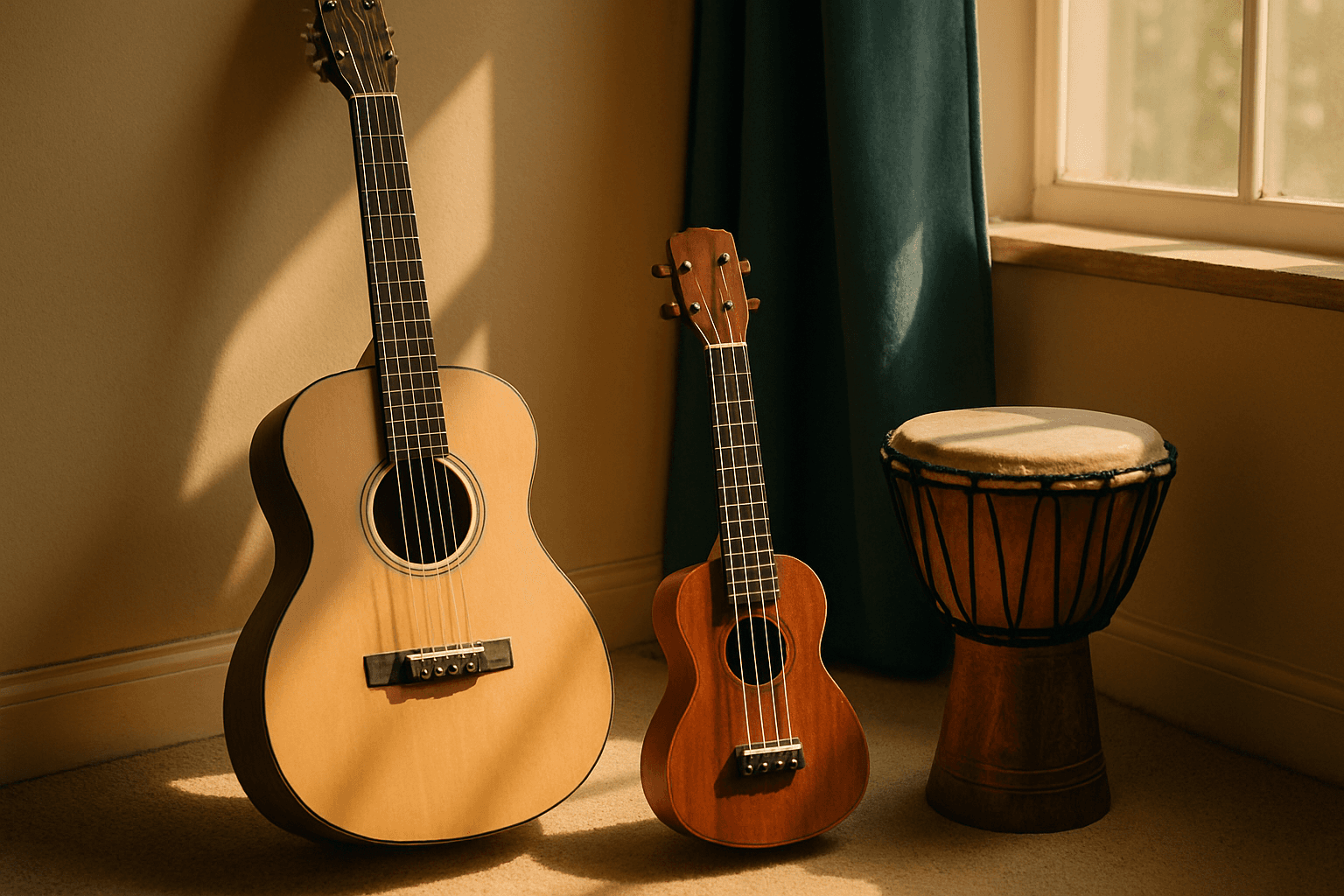
Ukulele or Guitar for Your First Instrument? An Honest Guide
Choosing ukulele or guitar as a first instrument? Compare cost, ease, and age-fit to pick the right stringed instrument for your child or yourself.
Choosing between ukulele and guitar as your first instrument comes down to age, hand size, budget, and how quickly you want to play a real song. For most children under ten and many adult beginners, ukulele offers a gentler, more affordable entry point, while guitar suits older learners with strong long-term motivation and larger hands.
How These Two Stringed Instruments Actually Differ
Choosing between a ukulele and a guitar is a bit like choosing between a bicycle and a motorcycle: both will get you riding, but one is lighter, simpler to balance, and far less intimidating on day one. Understanding what physically separates these two instruments helps you make the right call from the start. University music programs at institutions like James Madison University describe the ukulele and the guitar as members of the same plucked string-instrument family, yet their differences in scale, tension, and tuning make them genuinely distinct learning experiences from the very first lesson.
| Feature | Ukulele | Guitar |
|---|---|---|
| Strings | 4 | 6 |
| Body Length | ~53 cm (soprano) | ~100 cm (full-size) |
| String Material | Nylon | Steel (acoustic) or nylon (classical) |
| Typical Starter Cost (CAD) | $50–$120 | $120–$250 |
| Common Tuning | GCEA | EADGBE |
Size and body differences: why they matter for small hands
The soprano ukulele measures roughly 53 cm from end to end, while a full-size guitar stretches to approximately 100 cm. That gap is significant for small-handed players. Concert and tenor ukulele sizes offer intermediate options, slightly longer scale lengths, for growing children aged 8–10 who have outgrown soprano proportions but are not yet ready for a full guitar body. A smaller instrument body reduces wrist stretch and shoulder fatigue, and for children aged 5–8, the compact size and shape make it far easier to hold the instrument comfortably from day one.
String count, tuning, and how each instrument feels to hold
Guitar or ukulele differ fundamentally in string count: the guitar carries 6 strings tuned EADGBE, while the ukulele carries 4 strings tuned GCEA. Holding a ukulele against the body feels noticeably lighter and less tiring in the first weeks of learning. Nylon string tension is meaningfully lower than steel, which matters during a 20-minute practice session, your finger joints and wrist muscles are not working nearly as hard. That reduced physical demand keeps early learners focused on music rather than on managing discomfort.
Sound range and the musical genres each instrument suits best
A standard guitar spans more than four octaves, making it central to rock, blues, country, folk, and classical repertoire. The ukulele covers roughly 2.5 octaves and is particularly strong in pop, folk, Hawaiian, and singer-songwriter styles. Importantly, many contemporary pop songs, including Billboard chart hits from the 2010s onward, were recorded with ukulele prominently featured, so the instrument is far from limited. The baritone ukulele acts as a natural bridge between the two worlds, tuned DGBE and producing a warmer, deeper sound that edges closer to guitar territory.
How much does each instrument cost to start?
A quality beginner soprano ukulele retails for roughly CAD $50–$120, while a beginner acoustic guitar typically runs CAD $120–$250. Factor in a clip-on tuner (around $15) and a basic case (around $20–$40), and a complete ukulele starter setup lands at approximately $70–$140 all-in, versus $150–$280 for guitar. That lower initial outlay meaningfully reduces financial pressure on families who are testing whether a child will stick with lessons before committing to a larger investment. The NYT Wirecutter ukulele guide confirms that beginner ukuleles under $100 CAD can be genuinely good-quality instruments. For more detailed advice on what to buy, visit our gear-buying guides on the blog. See also: deciding between online and in-person lessons.
Which Is Easier to Learn, Guitar or Ukulele?
The answer to "which is easier to learn?" is almost never wrong, but the way most people frame the question is. Ease is not just about string count; it is about how quickly a beginner can produce a satisfying sound, form their first chord shape, and want to come back for another practice session tomorrow. Framing the question through a pedagogical lens, rather than a marketing one, gives you a far more useful answer.
Why ukulele has a gentler learning curve for absolute beginners
Learning ukulele puts fewer simultaneous demands on a beginner's hands and brain. With only 4 strings, fewer fingers need to be placed at once, and GCEA tuning means many chord shapes require just 1–2 fingers. That reduced cognitive load in the first four weeks directly supports motivation, you feel capable rather than overwhelmed. For Madison Curtis's teaching philosophy, the goal has always been to give students early, genuine competence rather than early, discouraging struggle. The ukulele's layout makes that goal achievable faster for most beginners.
How finger pressure and fret spacing affect early progress
Fret spacing on a soprano ukulele is narrower than on a guitar, reducing hand stretch for small or beginner hands. Nylon strings also require noticeably less pressing force, which means less finger soreness in weeks 1 and 2. Soreness is one of the primary reasons beginners quit within their first 30 days, an insight supported by motor-skill acquisition research published in the NIH/PMC database, which highlights how early physical discomfort interrupts the reinforcement loop that builds lasting practice habits. Gentler techniques during those fragile first sessions make a measurable difference in whether students continue.
Is it true that fewer strings makes ukulele easier to play?
Fewer strings does simplify chord shapes and strumming patterns, but it does not mean the string guitar has a monopoly on musical depth. "Easier to start" does not equal "easier to master." The ukulele rewards lifelong study just as the guitar does. One practical advantage worth noting: the ukulele's 4-string layout shares conceptual logic with the top 4 strings of a guitar, which matters when players later transition. The chord-diagram reading skills, the strumming coordination, and the finger muscle memory developed on a 4-string instrument transfer directly, shortening the adjustment period considerably.
How quickly can a beginner play a real song on each instrument?
Most beginners can start learning a recognisable song on ukulele within 1–2 weeks of consistent 15-minute daily practice, "Somewhere Over the Rainbow" is a perennial first-song favourite for good reason. On guitar, a clean-sounding simple song typically takes 3–6 weeks; "A Horse With No Name" by America is a popular early milestone. Neither timeline is a race. But early wins are a documented factor in long-term musical perseverance, the student who plays something they recognise in week 2 is statistically more likely to still be playing at month 6. Framing the learning timeline honestly helps both parents and students set realistic, motivating goals. See also: Find a qualified guitar teacher for structured learning.
Ukulele or Guitar for Kids, What Age and Size Tell Us
What if the single most important factor in whether your child sticks with music lessons is not the instrument's prestige, but whether their hands can actually reach the chords? Age and physical development shape this decision more than most parents realise. Matching instrument size to developmental stage is not a compromise; it is the most direct route to building confident, technically sound young musicians.
Age and Instrument Size Quick Guide
- Ages 5–7: Soprano ukulele (53 cm), ideal fit for small hands and short finger span
- Ages 8–10: Concert or tenor ukulele, or a 3/4-size guitar, suits growing hands
- Ages 11–12+: Full-size guitar appropriate for most learners depending on hand span
- Adults (any age): Either instrument is accessible; choose based on musical goals and budget
Motor-skill development research consistently reinforces that smaller, lighter instruments reduce the compensatory tension habits that are notoriously difficult to unlearn later.
What age is best to start ukulele lessons versus guitar lessons?
Ages 5–7 are particularly well-suited to ukulele because the body size and shorter finger span align naturally with the instrument's compact dimensions. Guitar lessons are generally recommended from age 8 or older with a 3/4-size instrument, and from ages 11–12 for a full-size model, depending on hand span. Starting on an instrument that is too large creates poor posture habits, hunched shoulders, over-stretched wrists, that can take years to correct. Beginning on the right-sized instrument for your child's age is one of the most straightforward things a family can do to protect long-term progress.
Motor-skill development: why a smaller instrument body builds better habits early
Early postural and grip habits are genuinely difficult to unlearn, this is well-established in motor-skill acquisition literature. When a young child has to over-stretch their wrist or crane their shoulder to hold a full-size instrument, the body compensates in ways that become ingrained. A lighter instrument with a compact body allows the child to hold it with relaxed, natural alignment from day one. Those relaxed techniques translate directly into better long-term outcomes: the young guitarist who learned on a correctly sized instrument consistently develops more efficient technique than one who struggled with an oversized one.
Keeping kids motivated: the role of early wins in music learning
Music learning research is consistent on one point: students who achieve recognisable results within the first 2–4 weeks are significantly more likely to continue past the 3-month mark. The concept of "early wins" is not a soft idea, it is a pedagogical mechanism. When a child can play a song their family recognises, they create a feedback loop of pride and curiosity that no amount of parental encouragement can fully substitute for. Ukulele's accessible chord shapes provide those early wins faster for most children under 10, supporting the long-term goal of building a joyful, lasting relationship with playing music.
The Real Benefits of Starting With Ukulele
In a 2017 survey of music teachers across North America, beginner dropout rates in the first 3 months were consistently cited as the field's biggest challenge. The instruments that kept students engaged longest had one thing in common: they delivered a sense of musical accomplishment quickly. The ukulele's design, fewer strings, softer materials, compact body, addresses nearly every reason beginners quit in those first difficult weeks.
Building chord vocabulary and strumming coordination from day one
Just 3–4 ukulele chords cover a remarkably wide range of songs, meaning a beginner can learn a genuinely diverse playlist without needing to master dozens of chord shapes first. Strumming patterns across 4 strings are also less complex to coordinate initially, freeing up mental attention for rhythm and timing. Building that chord vocabulary early creates a transferable musical framework, one that makes the eventual move to other instruments feel logical rather than like starting from scratch.
How nylon strings protect developing fingertips and build confidence
Music lessons on nylon-stringed instruments are significantly more comfortable in the first month than those on steel-string instruments. Steel strings cause meaningful finger soreness in weeks 1–4, and callus development on a steel-string acoustic can take 3–6 weeks. Pain is a primary driver of early quitting, not lack of talent, not lack of interest, but simple physical discomfort. The American Speech-Language-Hearing Association (ASHA) reminds us that comfortable sound and physical exposure matter for young learners, and that framing matters when building healthy habits early. For more on building a sustainable practice routine, visit tips on building a healthy practice routine on the blog.
Joy as pedagogy, why feeling successful fast actually matters
Music education research on intrinsic motivation is clear: joy and early competence are not peripheral goals, they are the mechanism by which students develop the discipline to tackle harder material later. A student who feels successful at week 2 is far more likely to be playing at month 6, and at year 3, than one who has spent those first weeks fighting an instrument that doesn't fit. When the goal is to create a lifelong musician, the fastest route is often the one that feels the most encouraging at the start. Feeling capable is how playing becomes a habit.
Can Learning Ukulele First Help You Transition to Guitar Later?
Some of the most respected guitarists of the 20th century, including George Harrison of The Beatles, began their musical journey on smaller, simpler string instruments before graduating to guitar. The path from ukulele to guitar is well-worn and surprisingly logical. Far from being a detour, starting on ukulele can build the foundational skills that make the eventual move to guitar faster and more confident, as formal music education contexts at institutions like JMU recognise in how they sequence string instrument instruction.
Which skills transfer directly from ukulele to standard guitar
Chord-shape logic, strumming coordination, reading chord diagrams, rhythm counting, and ear training all transfer directly. The left-hand muscle memory developed from pressing strings on a ukulele is immediately applicable to guitar study. A student who can already navigate chord changes, maintain a strumming pattern, and read a chord diagram has a meaningful head start. Guitar or ukulele, the theoretical foundations of both instruments overlap far more than most beginners expect, and a guitarist who started on ukulele rarely feels they wasted their time.
What will feel different when you make the switch
Switching to bass guitar or acoustic involves some genuine adjustments: two extra strings to manage, wider fret spacing that requires greater hand stretch, and steel strings that will cause initial finger soreness again even for experienced ukulele players. The body of the guitar is also noticeably heavier. Tuning requires relearning chord shapes from scratch in several cases. These are real differences, but they are manageable, time-limited adjustments, not barriers. The tenor ukulele, or particularly the baritone ukulele (tuned DGBE, identical to the top 4 strings of a guitar), offers an optional bridge step for those who want a gradual transition rather than a single leap.
Is it better to start on guitar if guitar is your long-term goal?
Acknowledging the counter-argument honestly: yes, starting on classical guitar or an acoustic directly is a valid and sometimes preferable choice, particularly for older beginners in their teens or adult years who have strong motivation, larger hands, and clear long-term intent. For those learners, the extra challenge of a 6-string from day one may actually provide the engagement they need. However, for children under 10, ukulele remains the more developmentally appropriate entry point in most cases. Neither path is universally superior. The goal is to learn ukulele or guitar in a way that matches where you are right now, not where you hope to be in five years.
How to Choose Between Ukulele and Guitar for Your Specific Situation
One parent recently asked: "My daughter loves Taylor Swift, should she start on guitar?" The honest answer was not a simple yes or no. It depended on her age, her hand size, her budget, and one question most guides skip: how much frustration can she sit with in week 3 before she walks away? Most Taylor Swift songs are fully playable on both ukulele and guitar with basic chords, so the music itself doesn't decide the question, the learner does.
Key questions to ask before making the decision
5 Questions to Ask Before Choosing an Instrument
- Age and hand size: Is the learner under 8? Ukulele is almost always the better fit. Ages 8–10 can go either way with the right-sized instrument.
- Budget: A full ukulele starter setup runs roughly CAD $70–$140; a full guitar setup runs CAD $150–$280.
- Favourite music style: Both instruments cover pop, folk, and singer-songwriter. Guitar adds rock, blues, and country range.
- Frustration tolerance: Younger children and first-time learners generally progress faster and stay motivated longer on ukulele in the first 8 weeks.
- Access to a teacher and lesson availability: The best instrument is often the one your local teacher knows best. Healthy practice habits, and guidance from ASHA on hearing-safe listening habits, matter for young learners regardless of which instrument you choose.
The instrument you start on is not a life sentence. It is an on-ramp. Choose the one that makes the first 90 days feel achievable, and the rest will follow naturally. Play the guitar, learn ukulele, or do both, what matters most is that you begin.
Key Takeaways
- Ukulele is typically the easier starting point for children under 10 and adult beginners with no prior music experience, thanks to fewer strings, softer nylon strings, and a compact body size.
- Physical fit matters as much as musical preference, starting on an instrument that is too large creates poor posture and tension habits that are hard to undo later.
- Early wins drive long-term motivation, most ukulele beginners play a recognisable song within 1–2 weeks, compared to 3–6 weeks on guitar.
- Ukulele skills transfer well to guitar, chord logic, strumming coordination, and ear training all carry over, and a baritone ukulele bridges the gap even further.
- Neither choice is wrong, older teens and adults with clear guitar goals can start directly on guitar; for younger children, ukulele nearly always provides the most encouraging developmental entry point.
FAQ
Is ukulele easier than guitar for a complete beginner?
For most beginners, yes, ukulele is generally more accessible in the first 4–8 weeks. Key reasons include:
- Only 4 strings to manage versus 6
- Many chord shapes require just 1–2 fingers
- Nylon strings require roughly 20–30% less finger pressure than light steel strings
- A recognisable first song is typically achievable within 1–2 weeks of daily 15-minute practice
That said, "easier to start" does not mean "easier to master", both instruments reward serious, long-term study equally.
What age is best to start learning ukulele?
Children aged 5–7 are particularly well-suited to soprano ukulele because the instrument's compact size aligns with their smaller hands and shorter arm span. Ages 8–10 often move to concert or tenor ukulele. Starting too early on a full-size guitar risks building poor posture and tension habits. For most children under 10, ukulele is the more developmentally appropriate first instrument regardless of long-term musical goals.
Can I switch from ukulele to guitar later?
Yes, and the transition is more logical than most people expect. Skills that transfer directly include:
- Chord-shape logic and diagram reading
- Strumming coordination and rhythm counting
- Left-hand muscle memory for fretting strings
- Ear training and basic music theory
Most students with 6 months of ukulele experience adapt to basic guitar within 4–8 weeks. The baritone ukulele (tuned DGBE, matching the top 4 strings of a guitar) is an optional stepping stone for a more gradual transition.
How much does a starter ukulele cost in Canada?
A reputable beginner soprano ukulele in Canada typically retails for CAD $50–$120. Adding a clip-on tuner (around $15) and a basic gig bag (around $20–$30) brings the full starter setup to approximately $70–$140. This is meaningfully less than a comparable beginner guitar setup, which runs roughly $150–$280 all-in. Lower upfront cost reduces financial pressure while families assess whether a child will commit to regular lessons and practice.
Does learning ukulele help you become a better guitarist later?
It can, yes. The chord vocabulary, strumming coordination, rhythm awareness, and finger dexterity developed on ukulele all apply directly to guitar. The primary adjustments when switching are managing two additional strings, wider fret spacing, and the initial soreness of steel strings. A student arriving at guitar lessons with 6–12 months of ukulele experience typically progresses faster through beginner guitar material than a true first-time starter, the foundational musical thinking is already in place.