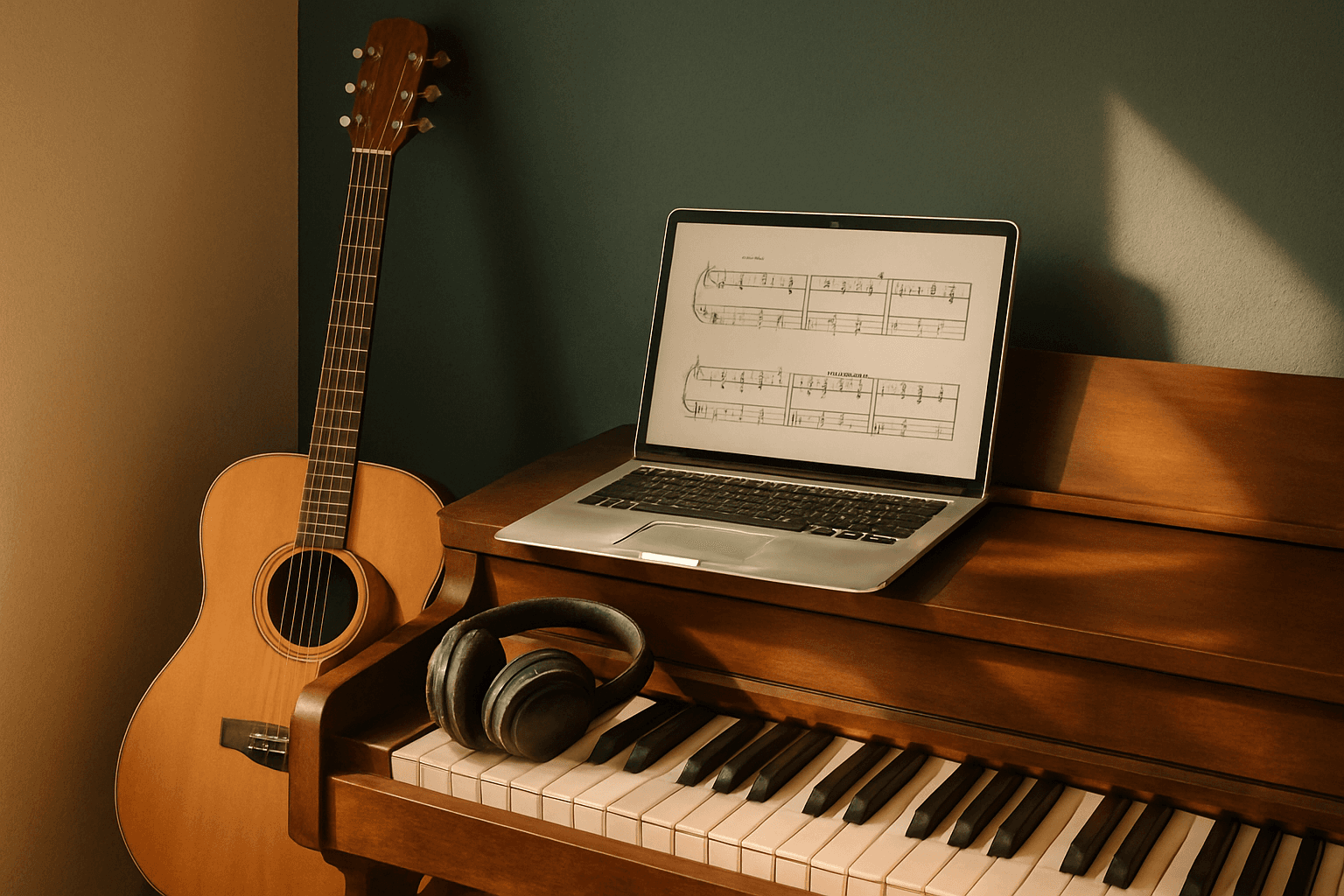
Online Piano Lessons: How to Learn, Choose a Teacher, and Find Your Best Fit
Find the right online piano teacher, set a clear learning path, and understand real costs. Practical advice for parents and adult learners across Canada.
Online piano lessons work, and the research backs that up. Whether you are a curious adult or a parent enrolling a child, a skilled teacher can deliver precise, real-time feedback on posture, touch, and timing through a screen. This guide walks you through how to start, what to look for in a teacher, and what progress genuinely looks like.
Why Online Piano Lessons Actually Work (The Pedagogy Behind the Screen)
Many parents and adult learners assume that piano is one instrument that simply cannot be taught well through a screen. In fact, the core of effective piano instruction, which includes precise, real-time feedback on posture, touch, and timing, translates remarkably well to video, and the evidence from working piano teachers across Canada backs this up.
How real-time video preserves the teacher-student feedback loop
The teacher-student feedback loop works like this: the teacher observes, identifies an error, corrects verbally or visually, and the student adjusts. Over a well-configured video call, this cycle operates in real time. A skilled teacher positions the camera to capture both hands simultaneously, preserving the visual information needed to catch tension in the wrist or a collapsed finger joint. Instant feedback corrections during a live lesson can happen within 2 to 3 seconds, which is well within the window needed for a learner to connect the correction to the physical sensation they just produced.
Motor-skill development at the piano: does format affect progress?
Finger independence, bilateral coordination, and muscle memory are built through repetition between lessons, not during them. When you learn piano, the format of instruction affects the quality of guidance you receive, not the practice hours that drive motor learning. Playing scales and exercises daily is what builds the neural pathways; the teacher's role is to ensure those repetitions are correct. Research in motor learning suggests most consolidation happens in the 24 to 48 hours after a focused practice session, meaning the work done at home is the engine of progress regardless of whether lessons happen online or in person.
What research and experienced piano teachers say about online learning outcomes
Distance music education research indicates that students in structured online piano lessons achieve comparable milestone progress to in-person peers within 12 months of consistent study. Experienced piano teachers report that the vast majority of technical corrections, covering bow angle, hand position, fingering, and articulation, can be communicated effectively via video. The Royal Conservatory of Music in Canada, one of the country's most respected music institutions, now offers online examination options, which represents meaningful institutional validation of screen-based music education. For structured, pedagogically grounded online lesson platforms, Hoffman Academy is a widely used example that reflects current best practices in remote piano pedagogy. If you are weighing online study against finding a local teacher, our guide to piano lessons near me walks through both options clearly.
How to Learn Piano Online: A Clear Path from First Note to Confident Playing
Picture a 10-year-old in Winnipeg, Manitoba, sitting at a secondhand keyboard in the living room on a Tuesday evening. Within 6 months of weekly online lessons and daily 15-minute practice sessions, she was playing a simplified version of her favourite song from memory. That kind of progress is ordinary when a clear learning path is in place.
What should a complete beginner do first?
Starting well matters more than starting fast. Here are four steps every beginner should take in order:
- Secure an instrument. A 61-key keyboard with touch sensitivity is a workable starting point and keeps costs manageable.
- Book a first lesson with a qualified teacher to establish correct posture and hand position from day one.
- Learn Middle C position and basic note reading within the first 2 lessons so you have a framework for everything that follows.
- Establish a daily 15-minute practice habit before adding complexity. Consistency at this stage outweighs session length.
For parents helping a child build that daily habit, the piano practice schedule for kids guide offers a ready-made routine framework.
Building finger independence and hand coordination through structured online practice
Finger independence is the primary physical challenge of early piano study, and it is addressed directly in structured online piano lessons through assigned exercises. Online teachers regularly prescribe five-finger patterns and contrary-motion scales, which students practise at home and then perform on camera for correction at the next session. Hanon exercises are a standard tool here, isolating each finger pair to build even, controlled touch. Bilateral hand coordination, meaning the left hand holding a bassline while the right hand carries the melody, is introduced gradually, typically in months 2 through 4 of study. Most beginners need 4 to 6 weeks of daily repetition before a new motor pattern begins to feel automatic rather than effortful.
How long does it realistically take to learn piano online?
Honesty about timelines saves learners from disappointment. Defined at three levels, progress looks like this: playing a simple piece with both hands is reachable within 3 to 6 months for most students; comfortable intermediate repertoire takes roughly 2 to 3 years; advanced or professional fluency requires 8 to 10 or more years of sustained study. These timelines assume 30-minute weekly lessons and 15 to 20 minutes of daily practice. The online format does not meaningfully shorten or lengthen these benchmarks, because the time variable that matters most is daily practice, not the medium of instruction. Piano Nanny is a free self-paced resource that beginners can use between lessons to reinforce note-reading and basic theory at their own pace.
Setting up your practice space at home for the best results
A well-configured home setup removes friction from every lesson and every practice session. Here are the key elements:
- Stable internet connection with a minimum of 10 Mbps download and upload speed to prevent lag during video lessons.
- A touch-sensitive keyboard positioned so the camera can see both hands and your seated posture; 61 keys is acceptable for beginners, though 88 weighted keys gives the most realistic motor feedback.
- Good ambient lighting directed at your hands and face; avoid sitting with a bright window behind you, as backlighting makes you hard to see.
- A device stand or adjustable camera mount so your teacher can see your hand position without you having to hold the camera.
- Headphones, which are optional but useful for apartment dwellers who want to practise without disturbing neighbours.
A useful app for supplementary ear-training and play-along practice can also be added once basic reading is established.
Online Piano Lessons for Kids: What Parents in Canada Need to Know
Is your child genuinely ready for online piano lessons, or would they spend the whole session spinning in their chair? Age, attention span, and the right teacher make the difference between a child who falls in love with music and one who quietly dreads lesson day.
5 signs your child is ready to start online piano lessons:
- Shows genuine interest in music or specific songs they want to play
- Can sustain focused attention on a single activity for approximately 15 to 20 minutes
- Has basic left/right hand awareness
- Can sit reasonably still in front of a screen for a structured activity
- Has access to a keyboard or piano at home
At what age can children start online piano lessons?
Most qualified piano students begin online instruction between ages 5 and 7. Below age 5, fine motor control and the ability to sustain screen-based attention are typically insufficient for productive sessions. The 7 to 10 age range is often the sweet spot: children at this stage are curious and motivated, their fingers are developing the strength and independence needed for keyboard playing, and they can follow screen-based instruction reliably. Age 5 is generally the practical minimum for a beginner starting online rather than in person. For guidance on how frequently young students should have lessons, our article on how often kids should have music lessons provides age-specific recommendations.
How does a good teacher hold a young learner's attention on screen?
Strong children's piano teachers build variety directly into the lesson structure. Activity rotations every 5 to 7 minutes prevent attention from drifting; a child might spend five minutes on a new piece, then shift to a clapping rhythm game, then move to flashcard note recognition shown on camera. Song choices matched to a child's current interests, whether that is a favourite film score or a pop song they hear at home, create intrinsic motivation that keeps young learners engaged across a full 30-minute session. For children under 8, a skilled teacher shifts the activity type every 5 minutes as a deliberate pacing strategy, not an improvised response to fidgeting.
Signs that an online piano teacher is genuinely child-focused
When researching options, resources like Pianote's comparison of online piano lesson options can help you understand what quality instruction looks like before you book. Here are observable signs that a teacher genuinely centres the child's experience:
- Uses repertoire the child recognises and enjoys, rather than exclusively standard method-book pieces
- Celebrates small wins explicitly and specifically, naming what the student did well
- Structures each lesson in short, varied activity blocks rather than one continuous task
- Communicates lesson goals and progress notes to parents after each session
- Adjusts the lesson plan in real time when the child is fatigued or frustrated
- Never shames a child for a missed practice week or a piece that needs more time
For a deeper look at what distinguishes excellent instruction at any age, see our guide on what makes a good music teacher.
How to Choose an Online Piano Teacher That's Right for You
A survey of North American music parents found that a large share of families who quit private lessons in the first year cited poor teacher fit, not lack of interest in music, as the primary reason. Choosing the right online piano teacher from the start has a measurable impact on how long a student sticks with the instrument.
Credentials and training: what actually matters vs. what sounds impressive
There is an important distinction between meaningful credentials and impressive-sounding ones. The ARCT (Associate of the Royal Conservatory of Music) designation requires a minimum of Grade 10 RCM examination standing alongside a dedicated pedagogy component, making it a genuinely relevant marker of teaching readiness. A BMus from an accredited music school or academy similarly signals structured study of both performance and pedagogy. What matters less, on its own, is decades of personal playing experience without any formal training in how students learn. A professional performer who has never studied teaching methods may be a wonderful musician but an inconsistent teacher. Look for documented student progress, parent testimonials, and evidence of pedagogical training alongside performance credentials.
What questions should you ask before booking a first lesson?
Use these five questions to evaluate any teacher before you commit:
- What is your teaching philosophy, and how do you structure lessons for my level or my child's age?
- What curriculum or method books do you use, and why?
- How do you communicate progress to parents or adult students between lessons?
- What is your cancellation and rescheduling policy? (Standard cancellation windows are 24 to 48 hours notice.)
- Do you offer a trial lesson, and what does it cost?
You can browse teacher profiles with stated lesson structures and policies at Lessonface, which makes it straightforward to contact multiple teachers and compare their approaches before committing.
Private one-on-one lessons vs. group piano courses online: which is better?
The honest answer depends on your goals and learning style. Private lessons offer personalised pacing, direct instant feedback on technique, and repertoire chosen specifically for the student's taste and aspirations. For children, serious adult beginners, and anyone building a solid technical foundation, private instruction is the stronger choice. Group online piano courses offer a different value: they can be more affordable, socially motivating, and well-suited to casual adult learners who enjoy a community context. Many students use a group course as a structured supplement to private lessons rather than a replacement.
| Factor | Private Lessons | Group Online Course |
|---|---|---|
| Personalisation | High; tailored to student | Low; standardised curriculum |
| Pacing | Flexible to student's needs | Set by course schedule |
| Cost | CAD $40–$100 per hour | Often CAD $10–$30 per month |
| Social element | One-on-one only | Community of learners |
| Best for | Children, focused adult learners | Casual adults, supplementary study |
Red flags to watch for when evaluating online piano teachers
Not every teacher advertising lessons online offers quality instruction. Watch for these warning signs:
- No clear lesson structure or stated curriculum when asked directly
- Reluctance to provide references, student testimonials, or examples of student progress
- No stated cancellation or rescheduling policy, or a vague one
- Requests payment for 10 or more lessons upfront before offering any trial lesson
- Dismisses the student's musical interests or song preferences as unworthy of study
- Poor audio or video setup that makes it genuinely difficult to hear playing or see hand position clearly
Understanding the Cost of Online Piano Lessons
Private music lessons have long carried a reputation as an expensive luxury. In Canada, that changed meaningfully with the rise of online piano lessons: geography no longer restricts families to whoever is within driving distance, and competition among qualified teachers has created a broader price range than existed a decade ago.
What is the typical price range for online piano lessons in Canada?
For a 60-minute online lesson in Canada, expect to pay between CAD $40 and $100, depending on teacher experience, credentials, and platform. Teachers earlier in their careers or still completing a music degree typically sit closer to the $40 end. Experienced, credentialed professionals with a documented track record of student progress generally range from $70 to $100 per hour. It is worth noting that platform fees on third-party marketplaces can add an additional 10 to 15% to the listed rate, so compare teacher rates on platforms like Lessonface alongside direct bookings when budgeting.
What affects lesson pricing: teacher experience, lesson length, and lesson frequency
Three factors move the price most significantly. First, teacher credentials and active teaching experience: ARCT and BMus-qualified teachers with years of studio experience typically charge more than self-taught instructors, and the premium usually reflects real differences in pedagogical depth. Second, lesson length: 30-minute sessions are more affordable but compress the time available for both technical work and repertoire development. Third, lesson frequency: many teachers offer a small discount of 5 to 10% for committed weekly bookings compared to ad hoc scheduling, making a regular weekly commitment both pedagogically sound and slightly more economical over a full year of learning.
Is a 30-minute, 45-minute, or 60-minute online piano lesson the right fit for your goals?
Age and goals should drive this decision. Children aged 5 to 8 benefit most from 30-minute lessons; attention and energy limits make longer sessions counterproductive, and a skilled teacher can accomplish a great deal in a focused half-hour. Students aged 9 to 12 are well suited to 45-minute lessons, which allow enough time for warm-up, repertoire work, and brief theory integration without pushing past a young learner's stamina. Teenagers and adults working toward a musical journey with clear repertoire goals, exam preparation such as sight reading requirements in RCM syllabi, or an interest in exploring chord progressions and sheet music from multiple genres benefit most from the full 60-minute format. Adults who are learning casually alongside a busy schedule may find that 30 or 45 minutes fits their life better than an hour, and a good teacher will structure those shorter sessions to remain productive. The key is choosing a length you can commit to consistently week over week.
Key Takeaways
- Online piano lessons deliver comparable progress to in-person study when a qualified teacher, a touch-sensitive instrument, and a stable internet connection are in place.
- Beginners of any age should expect 3 to 6 months of consistent weekly lessons and daily 15 to 20-minute practice before playing a simple two-hand piece with confidence.
- Children aged 5 to 7 are typically ready to begin; look for teachers who rotate activities every 5 to 7 minutes to match young learners' attention spans.
- Teacher fit matters more than platform or price; ask about credentials, teaching philosophy, and trial lesson policy before committing.
- Budget CAD $40 to $100 per 60-minute lesson in Canada, and consider whether private lessons, a group course, or a combination serves your specific goals and learning style best.
FAQ
Are online piano lessons as effective as in-person lessons?
For the large majority of students, yes. Real-time video allows a teacher to observe hand position, posture, and timing with enough clarity to deliver meaningful corrections. The Royal Conservatory of Music in Canada now supports online examinations, reflecting institutional confidence in the format. Progress timelines in structured online piano lessons are comparable to in-person study, particularly when students practise consistently between sessions.
What equipment do I need to take online piano lessons?
You need four things:
- A touch-sensitive keyboard (minimum 61 keys; 88 weighted keys is ideal for realistic motor feedback)
- A device with a camera (tablet, laptop, or desktop) capable of showing both your hands and posture
- A stable internet connection of at least 10 Mbps
- A video platform your teacher uses, such as Zoom or Skype
Good lighting directed at your hands and face improves the teacher's ability to observe your technique.
How much do online piano lessons cost in Canada?
Typical rates in Canada range from CAD $40 to $100 per 60-minute lesson. Thirty-minute lessons generally run CAD $20 to $50, making them accessible for younger beginners. Teacher credentials, years of experience, and platform fees all influence the final price. Some teachers offer a 5 to 10% discount for weekly committed bookings compared to ad hoc scheduling.
What is Simply Piano and how does it compare to lessons with a real teacher?
Simply Piano is an app-based learning tool that uses your device's microphone to detect what you play and guide you through songs and exercises with piano by pictures and visual cues. It is engaging and affordable, and useful for supplementary practice between lessons. It does not replace a qualified teacher, because it cannot observe posture, correct technique at a joint level, or adapt to a student's individual challenges the way a live instructor can.
At what age should a child start piano lessons online?
Most qualified teachers recommend starting between ages 5 and 7, with age 5 as the practical minimum for online (rather than in-person) instruction. Children below age 5 typically lack the fine motor control and screen attention needed for productive online sessions. Ages 7 to 10 are often ideal, as children at this stage have developing finger strength, curiosity, and the ability to follow structured screen-based instruction reliably.