The Best First Instrument for a Child (And How to Actually Choose One)
Not sure which instrument your child should learn first? A music educator breaks down piano, guitar, voice, and more, with honest, practical guidance for parents.
Your child has been humming every song on the radio, begging to 'learn music', and now you're staring down a wall of options: piano, guitar, violin, ukulele. More choices rarely means more clarity. This guide cuts through the noise and helps you find the instrument that's genuinely the right fit for your child.
Why the "Best" Instrument Is Different for Every Child
Here's the honest truth: there is no single winner. The question isn't which instrument tops a chart, it's which instrument matches where your child is developmentally, emotionally, and physically right now.
Fine motor skills, the precise, coordinated movements of small fingers, develop on their own timeline, not a calendar one. A child who is physically ready to navigate piano keys at age five might not have the sustained attention span for structured lessons until seven. And some instruments simply require biology your child hasn't grown into yet: a five-year-old's lungs genuinely cannot sustain the breath pressure a trumpet or oboe demands. That's not a limitation; it's just anatomy.
The goal here isn't finding the "best" instrument in the abstract. It's finding the best fit for your specific child. Research on musical training and children's cognitive development shows that measurable cognitive benefits emerge early, which is exactly why getting that fit right from the start is worth a little extra thought. Learning music is already enough of a starting point. Everything else is a process of discovery.
--- See also: finding the right lesson format for your child.
The Four Things That Actually Matter When Choosing
Forget the ranking articles for a moment. When it comes to picking an instrument, four factors matter more than anything else.
1. Age and physical development. Small hands need musical instruments sized for them, half- and three-quarter-size guitars and violins exist precisely for this reason. Fine motor coordination typically reaches a workable baseline for piano or strings around ages five to six, though every child develops differently. Breath-control instruments like flute, clarinet, and trumpet generally suit ages seven and up, when lung capacity and lip strength have had more time to develop.
2. What your child is already drawn to. Intrinsic motivation is the single strongest predictor of whether a child sticks with music lessons. If your child is air-drumming at dinner, singing along to every song in the car, or asking "what instrument is that?" during movie soundtracks, that's real, usable data. Ask them what they want to play. Don't decide for them.
3. Your household's practical reality. Cost, space, and noise tolerance are all legitimate factors, not shallow ones.
| Instrument | Typical Starter Cost | Space Needed | Noise Level |
|---|---|---|---|
| Ukulele | $50–$80 | Minimal | Low |
| Keyboard (weighted) | $150–$300 | Small–medium | Low–medium |
| Acoustic guitar | $100–$200 | Minimal | Medium |
| Violin (rental) | $15–$25/month | Minimal | Medium–high |
| Drum kit (acoustic) | $300–$600+ | Large | Very high |
| Electronic drum kit | $200–$500 | Medium | Low |
| Recorder | $10–$20 | Minimal | Medium |
A drum kit in a one-bedroom apartment is simply a different decision than a drum kit in a house with a garage. Both can work, with honest planning.
4. Access to a great teacher. This one is the most underrated factor on the whole list. The instrument matters far less than the relationship your child has with the right instructor. A mediocre fit with a brilliant teacher beats a perfect instrument with the wrong one, every single time.
If you want to go deeper on any of these four factors, the International School of Music has a thorough guide on choosing a first instrument based on your child's age, interest, and physical fit that's worth bookmarking.
--- See also: finding a qualified guitar teacher for kids.
A Closer Look at the Most Common Starter Instruments
Let's look honestly at the options you're most likely to encounter, and who each one suits best. Understanding what it takes to learn how to play each instrument will help you match the right one to your child's personality and readiness.
Piano / keyboard. Piano builds muscle memory and note-reading in both treble and bass clef simultaneously, giving young learners a genuine head-start in music theory. There's no pitch-matching required from day one (unlike violin), which lowers the frustration barrier considerably. One important distinction: a weighted, full-size keyboard is meaningfully different from a toy, action matters for technique development. Great for ages five and up.
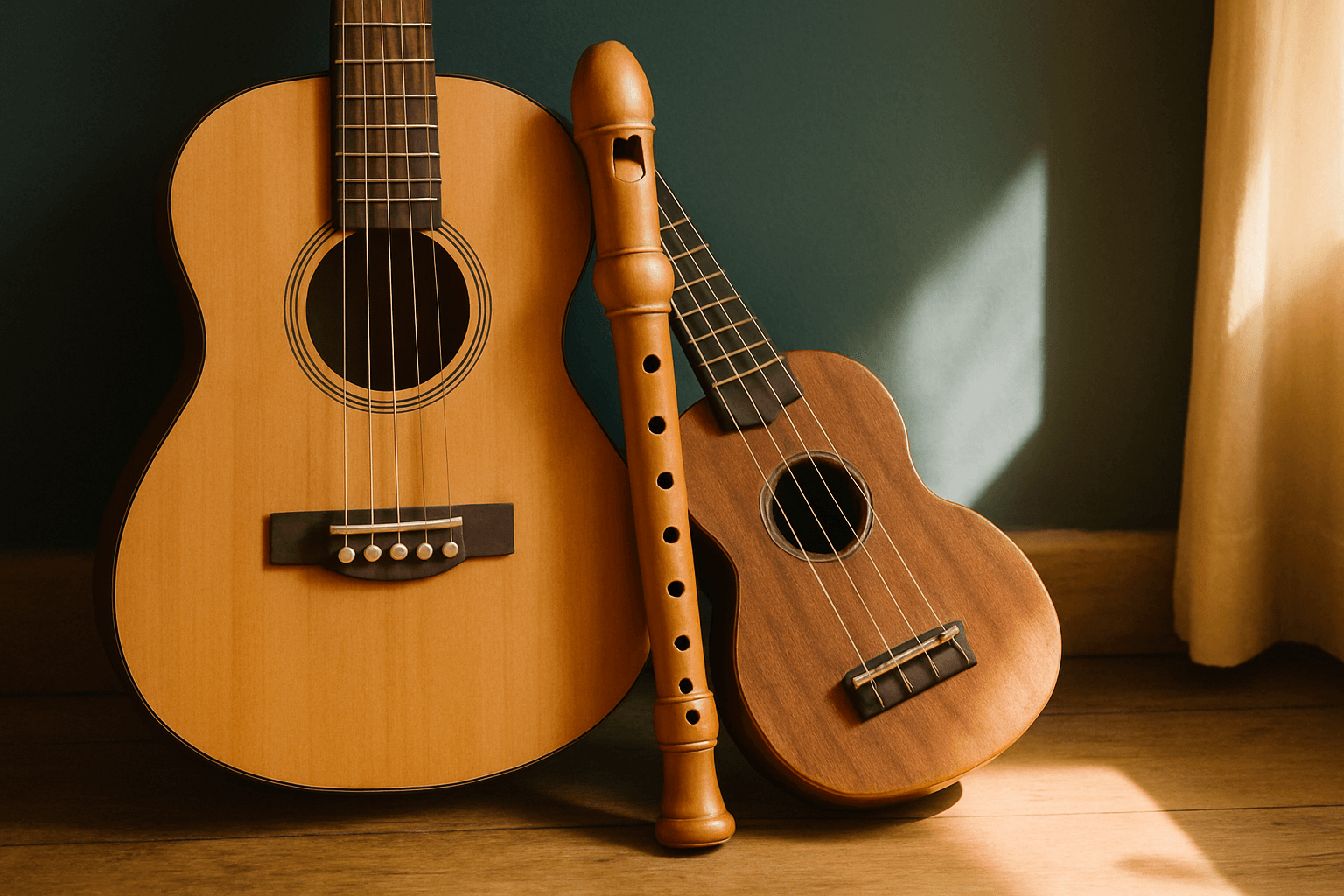
Ukulele. Low string tension is genuinely gentle on small fingers, none of the callus-building pain phase that guitar learning an instrument requires. Quick chord wins (many songs use just two or three chords) build confidence fast, which keeps kids coming back. Portable, affordable, and fun. Some children fall completely in love with the ukulele long-term; others use it as a bridge to guitar. Both outcomes are excellent.
Recorder. Underrated and underestimated, this is a real instrument, not a toy. It's an excellent first step for breath control and note-reading before moving to flute or clarinet, and at $10–$20, the financial commitment is negligible. Widely used in elementary school music programs for good reason.
Violin and cello. Every string instrument in this family comes in fractional sizes small enough for very young children, a 1/16 violin can fit a three-year-old. The learning curve is steeper than piano or ukulele, and they genuinely require a patient, skilled teacher, that's worth naming plainly. Many families also discover that classical music becomes a natural gateway when children start on strings; the repertoire is vast, and the structured teaching tradition is particularly well-developed. But for children who love a challenge and respond well to structure, the long-term reward is extraordinary.
Drums and percussion instruments. Perfect for high-energy kids to learn rhythm through movement and feel. A drum kit builds rhythm literacy that transfers directly to every other instrument a child will ever play, and percussion instruments more broadly, from hand drums to xylophones, are an excellent low-barrier entry point. Practical noise solutions exist: electronic drum kits, practice pads, or clearly negotiated "drum hours" with the household.
Voice. More on this in the next section, because it genuinely deserves its own space.
Want even more detail on each of these options? This comprehensive guide to beginner instruments for kids from Merit Music goes instrument by instrument with age and physical considerations that are genuinely helpful.
A Note on Singing as a First "Instrument", Why It's So Often Overlooked
Most parents don't think of music lessons for the voice when they're searching for the best first instrument for a child. They should.
Every child already owns this instrument. Zero cost, zero equipment, zero logistics barrier, your child walks in the door with it. Singing develops pitch accuracy, rhythm, dynamics, breath support, and expressive phrasing, and every single one of those musical skills transfers directly to any future instrument they pick up. Starting with voice doesn't mean staying with voice; it means building a foundation that makes everything else easier.
There's one thing worth knowing about children's voices specifically: they are literally still growing. The vocal anatomy, the folds, the cartilage, the resonating spaces, changes throughout childhood and adolescence. This is why the quality of the teacher matters especially here. A nurturing, knowledgeable teacher protects a young voice and helps it develop healthily; the wrong approach can create strain. This isn't a reason to avoid singing lessons, it's a reason to choose the right teacher with care.
The benefits of singing extend well beyond the music room, too. Confidence, communication, breathing under pressure, expressive storytelling, these are life skills that happen to be built through song. The National Endowment for the Arts on childhood arts experiences and long-term development found that early arts engagement supports social-emotional growth and academic success in measurable ways. Singing lessons aren't only for children who dream of performing on a stage. They're for any child who loves music and wants to feel it more deeply.
Signs Your Child Is Ready to Start Lessons (At Any Age)
Alongside the instrument question, most parents are quietly asking a second one: Is my child actually ready? Here are four observable signs, no developmental screening required.
They ask about music persistently. Not once after a movie, but repeatedly, over days or weeks. That sustained curiosity is meaningful.
They can follow simple sequential instructions for 10–15 minutes. That's the basic attention span a first lesson requires. It doesn't need to be perfect, just workable.
They respond physically or emotionally to music. Humming, moving, asking what an instrument is, these are signs they're already listening actively, not passively.
They want to make the sound, not just hear it. There's a specific spark when a child reaches for an instrument rather than just watching someone else play it. Notice that moment.
A note on age: four to five years old is early but absolutely possible with the right teacher and a playful format. Six to eight is a common sweet spot for most instruments. Teens starting from zero is completely normal and leads to genuine skill, don't let anyone tell you otherwise. And one more thing: you do not need to be musical yourself for your child to thrive. Your job is simply to show up and stay curious alongside them.
How to Test the Waters Before You Commit
You don't have to make a big decision to make a first move. Here are five low-stakes ways to start:
Rent before you buy. Most music stores offer monthly instrument rentals. Try before you commit to a purchase, it removes the financial risk almost entirely.
Book one trial lesson. Thirty minutes with a good teacher will tell you more than thirty hours of YouTube research. Most teachers offer intro sessions; take them up on it.
Let your child hold instruments. Physical exposure before a final decision. Some kids surprise you, and themselves.
Look into group intro classes. Low-pressure, social, and affordable; many community music schools offer them as a first step.
Reframe switching instruments. If your child starts guitar and wants to move to drums six months later, that is not failure. That is how musical identity develops, and everything they learned along the way transfers. You can explore more on this topic and read about teaching approaches over on the blog, or learn more about how lessons are structured on the Madison Curtis home page.
Key takeaways
- The best first instrument for a child is a matter of fit, physical development, natural interests, household practicality, and teacher quality all matter more than any ranking.
- Physical readiness varies: piano and strings suit ages five and up; breath instruments generally work better from age seven; voice lessons are appropriate at almost any age with the right teacher.
- Intrinsic motivation is the strongest predictor of whether a child sticks with music, ask your child what they want to play before you decide for them.
- Singing is a genuinely underrated first instrument that builds foundational musical skills transferable to every other instrument, at zero equipment cost.
- Testing the waters through a rental, a single trial lesson, or a group class is a low-risk, high-information way to move from researching to actually starting.
FAQ
What is the easiest instrument for a child to learn first?
Piano and ukulele are consistently the most beginner-friendly options for young children. Piano provides a visual, logical layout of notes with no pitch-matching required, while the ukulele's soft strings and quick chord wins build confidence fast. That said, "easiest" depends on your child, a rhythmically driven kid may find percussion instruments and the drum kit far more intuitive than either.
What age should a child start music lessons?
Most children are ready to begin structured music lessons somewhere between ages five and seven, when fine motor skills and basic attention span have developed enough for a lesson format. Some four-year-olds thrive in playful, short sessions with the right teacher. Teenagers starting from zero are absolutely not "too late", they often progress quickly because their cognitive maturity helps them understand music theory more readily.
Should I let my child choose their own instrument?
Yes, with some gentle guidance on practical realities. A child who chooses their own instrument has built-in motivation that will carry them through the harder practice days. Your role is to help them understand the options, try a few if possible, and then support their choice. The instrument they pick excitedly is almost always better than the one you pick for them carefully.
Is piano a good first instrument for kids?
Piano is widely considered one of the best first instruments because it teaches note-reading in both clefs simultaneously, builds strong finger independence, and provides an immediate, satisfying sound without requiring pitch calibration. It lays a strong music theory foundation that makes learning an instrument for the second time significantly easier, and it's a natural gateway into classical music for children who develop a taste for it.
Are singing lessons a real option for young children, or is that better saved for older kids?
Singing lessons are a genuine and valuable option for children as young as five or six, provided the teacher has specific experience with young voices. Children's vocal anatomy is still developing, which means the teacher's approach matters a great deal, a nurturing, technique-focused teacher can support healthy vocal growth, build confidence, and develop musical ear in ways that benefit any instrument a child later chooses.
What if my child wants to switch instruments after starting?
Switching is normal, healthy, and not a sign of failure. Musical identity develops through exploration, and nearly every skill learned on one instrument, rhythm, note-reading, listening, muscle coordination, transfers to the next one. Treat an instrument switch as a sign your child is engaged with music and learning music more deeply, not as wasted time or money.